14.9.2015
Was Tom Hayes Running the Biggest Financial Conspiracy in History?
Or just taking the fall for one?
by Liam Vaughan and Gavin Finch
Bloomberg Businessweek
On a deserted trading floor, at the Tokyo headquarters of a Swiss bank, Tom Hayes sat rapt before a bank of eight computer screens. Collar askew, pale features pinched, blond hair mussed from a habit of pulling at it when he was deep in thought, the British trader was even more disheveled than usual. It was Sept. 15, 2008, and it looked, he would later recall, like the end of the world.
Hayes had been woken at dawn in his apartment by a call from his boss, telling him to get into the office immediately. In New York, Lehman Brothers was plunging into bankruptcy. At his desk, Hayes watched the world process the news and panic. Each market as it opened became a sea of flashing red as investors frantically dumped their holdings. In moments like this, Hayes entered an almost unconscious state, rapidly processing the tide of information before him and calculating the best escape route.
Hayes was a phenom at UBS, one of the best the bank had at trading derivatives. All year long, the financial crisis had been good for him. The chaos had let him buy cheaply from those desperate to get out, and sell high to the unlucky few who still needed to trade. While most dealers closed up shop in fear, Hayes, with his seemingly limitless appetite for risk, stayed in. He was 28 years old and he was up more than $70 million for the year.
Now that was under threat. Not only did Hayes have to extract himself from every deal he’d done with Lehman, but he’d made a series of enormous bets that in the coming days, interest rates would remain stable. The collapse of the fourth-largest investment bank in the U.S. would surely cause those rates, which were really just barometers of risk, to spike. As Hayes examined his tradebook, one rate mattered more than any other: the London interbank offered rate, or Libor, a benchmark that influenced $350 trillion of securities around the world. For traders like Hayes, this number was the Holy Grail. And two years earlier, he had discovered a way to rig it.
Libor was set by a self-selected, self-policing committee of the world’s largest banks. The rate measured how much it cost them to borrow from each other. Every morning, each bank submitted an estimate, an average was taken, and a number was published at midday. The process was repeated in different currencies. During his time as a junior trader in London, Hayes had gotten to know several of the 16 individuals responsible for making their bank’s daily submission for the Japanese yen. His stroke of genius was realizing that these men mostly relied on interdealer brokers, the fast-talking middlemen involved in every trade, for guidance on what to submit each day.
If Hayes could manipulate the system at the peak of the worst crisis in memory, there seemed to be no limit to what he could do next.
Hayes saw what no one else did because he was different. Hayes’s intimacy with numbers, his cold embrace of risk, and his manias were more than professional tics; they were signs that he’d been wired differently since birth. Hayes would not be officially diagnosed with Asperger’s syndrome until 2015, when he was 35, but his coworkers, many of them savvy operators from fancy schools, often reminded Hayes he wasn’t like them. They called him Rain Man. Most traders looked down on brokers as second-class citizens, too. Hayes recognized their worth. He’d been paying them to lie ever since he had.
By the time the market opened in London, Lehman’s death was official. Hayes instant-messaged one of his brokers in the U.K. capital to tell him what direction he wanted Libor to move. “Cash mate, really need it lower,” he typed, skipping any pleasantries. “What’s the score?” The broker sent his assurances, and, over the next few hours, followed a well-worn playbook. Whenever one of the Libor-setting banks called and asked his opinion on what the benchmark would do, the broker said—incredibly, given the calamitous news—that the rate was likely to fall. Libor was often called “the world’s most important number,” but this was how it was set: conversations among men who were, depending on the day, indifferent, optimistic, or frightened. When Hayes checked later that night, he saw to his inexpressible relief that yen Libor had fallen.
Hayes was not out of danger yet. Over the next three days, he barely left the office, surviving on three hours of sleep a night. As the market seesawed, his profit and loss in one stretch went from minus $20 million to plus $8 million in just hours. Amid the bedlam, Libor was the one thing Hayes had some control over. He cranked his network to the max, offering his brokers extra payments for their cooperation, and calling in favors at banks around the world. By Thursday, Sept. 18, Hayes was exhausted. This was the day he’d been working toward all week. If Libor jumped today, his puppeteering would have been for naught. Libor moves in increments called basis points, equal to one one-hundredth of a percentage point, and every tick was worth roughly $750,000 to his bottom line.
For the umpteenth time since Lehman faltered, Hayes dialed one of his most trusted brokers in London. “I need you to keep it as low as possible, all right?” Hayes said. “I’ll pay you, you know, $50,000, $100,000, whatever. Whatever you want, all right?”
“All right,” the broker repeated.
“I’m a man of my word,” Hayes said.
“I know you are. No, that’s done, right, leave it to me,” the broker said.
Hayes was still in the office when that day’s Libor was published at noon in London. The yen rate had fallen one basis point, while comparable money market rates in other currencies continued to soar. Hayes’s crisis had been averted. Using his network, he had personally tilted one of the central pillars of the planet’s financial infrastructure. He pulled off his headset and headed home to bed. He’d only recently upgraded from the superhero duvet he’d slept under since he was 8 years old.
_____________________________________________________________
Thomas William Alexander Hayes had always been an outsider. Raised in the urban sprawl of Hammersmith, West London, in the 1980s, Hayes was bright but found it hard to connect with other kids. His parents divorced when he was in primary school; when his mother remarried, he moved to the leafy, affluent town of Winchester. Hayes held onto his inner-city accent, traveling back to the capital on weekends to watch Queens Park Rangers, perennial underdogs.
Lots of British boys were die-hard football fans, but Hayes’s interest was something more like obsession. Fixations are a symptom of Asperger’s, along with social problems, elevated stress, and a propensity for numbers over words. The kids in Winchester bullied him for it. Hayes remained a peripheral figure in college, at the University of Nottingham. While his fellow students took their summer holidays, he paid for school by cleaning pots and lugging kitchen supplies for £2.70 an hour.
Seeking better money, Hayes won an internship at UBS in London. After graduating, in 2001, he joined Royal Bank of Scotland as a trainee on the interest rate derivatives desk. For 20 minutes a day, as a reward for making the tea and collecting dry cleaning, he was allowed to ask the traders anything he wanted. It was an epiphany. Unlike the messy interactions and hidden agendas that characterized day-to-day life, the formula for success in finance was clear: Make money and everything else will follow. It became Hayes’s guiding principle, and he began to read voraciously about markets, options pricing models, interest rate curves, and other financial arcana.
In the laddish, hedonistic culture of the money markets, the awkward 21-year-old was an odd fit. On the rare occasions he joined other bankers on their nights out, he stuck to hot chocolate. They called him “Tommy Chocolate,” and blurted out Rain Man quotes like “Qantas never crashed” as Hayes walked the trading floor. He was bad at banter, given to taking quips and digs at face value. The superhero duvet was a particular point of derision. The bedding was perfectly adequate, Hayes thought; he didn’t see the point in buying another one.
Not everyone in finance was a jerk. Hayes made a few friends, and he found that his machine-gun approach to messaging and trading made him a favorite among brokers, who didn’t care where a trader had gone to school as long as he brought them deals. And ultimately, Hayes went along with the jokes because the obsessive traits that had marginalized him socially turned into power the moment he logged on to his trading terminal. For all the ribbing, Hayes had found a place where he belonged. He rose early, worked at least 12 hours a day, and rarely stayed awake past 10 p.m. He often got up to check his trading positions during the night.
Particularly, Hayes was taking positions in interest rate swaps. Originally designed to protect companies from fluctuations in interest rates, swaps were now mostly bought and sold between professional traders at banks and hedge funds, another form of high-stakes security to wager on. The market for swaps was exploding. In 2000, $50 trillion of the securities changed hands every year. In 2010, it was $500 trillion. For Hayes, the complex calculations and constant mental exertion came easily, but he found he had something rarer: a steely stomach for risk. While other rookie traders looked to book gains or curb losses quickly, Hayes rode out volatile market swings. In those early years his results were mixed, but his superiors knew a natural when they saw one. In 2004, Hayes was headhunted by Royal Bank of Canada, a smaller outfit where Hayes could take a more prominent role. He was given his own trading book focused on the yen derivatives market.
Traders at the largest firms recall suddenly seeing minnow RBC taking the other side of big-ticket deals. Hayes may have been baffled by the simple rituals of office camaraderie, but when he looked at the serpentine matrix of yen derivatives he saw clarity. “The success of getting it right, the success of finding market inefficiencies, the success of identifying opportunities and then when you get it right—it’s like solving that equation,” Hayes would later say. “It’s make money, lose money, and it’s just so pure.”
In the summer of 2006, Hayes was poached again, this time by UBS. RBS, RBC, UBS—the name on the door mattered little to Hayes, as long as he had a phone, his screens, and the bank’s balance sheet to wager. The firm sent him to Tokyo, a major promotion that officially retired his image as a cocoa-sipping, blankie-clutching eccentric, and recognized him for what he’d become: an aggressive and formidable trader.
In poker, there are two types of player: tight folk who wait for the best hands, then bet big and hope to get paid; and hawks who can’t resist getting involved in every hand, needling opponents and scaring the nervous ones into folding. Hayes was firmly in the latter camp. His M.O. was to trade constantly, picking up snippets of information, racking up commissions as a market maker, and building a persona as a high-volume, high-stakes risk-taker.
Hayes moved to Japan just as the government raised interest rates for the first time in a generation, reinvigorating a multitrillion-dollar market that had been lying dormant. Most of the instruments he traded referenced Libor. There are Libor rates for all the major currencies, and for time frames ranging from overnight to 12 months. On any given trade, Libor was the single most important number that determined profit or loss. By now, Hayes knew that the art of trading involves building a sense of the future based on incomplete and evolving information. Where Libor would land tomorrow was the great unknowable. It became his mission to control the chaos around him, to eradicate the shades of gray. “I used to dream about Libor,” Hayes said years later. “They were my bread and butter, you know. That was the thing. They were the instrument that underlined everything that I traded. I was obsessed.”
_____________________________________________________________
Hayes loved his job, but when things weren’t going his way, he hated it just as fiercely. On the fifth floor of UBS’s Tokyo headquarters, he stared at his bank of screens, fuming. It was October 2006. He’d only been at the bank a matter of weeks and was already in a hole, on the losing side of a huge bet on the direction of short-term interest rates. Yen Libor was refusing to budge, and he was getting angrier.
While finance had been transformed by technology over the past quarter century, the way Libor was set remained rudimentary. Every day, banks in London told the British Bankers’ Association how much it might cost them to borrow in various currencies, for various lengths of time. There were 150 total combinations. For each one, the top and bottom quarter of figures are discarded, and the average of the remaining numbers became that day’s Libor. That was it. Libor was a component in securities ranging from U.S. student loans and credit cards to Kazakh gas futures, but it was determined each day by just a handful of distracted, guesstimating individuals.
Later that afternoon in Tokyo, Hayes was venting about his predicament to one of his London brokers, a trusted confidant. The broker offered to talk to his colleague, who was in charge of e-mailing a daily Libor prediction—unofficial but handy—to the small group of bankers that came up with the number. (The U.K. court has ordered that the two men cannot be named because they are facing trial.) The e-mail was supposed to be impartial, but if Hayes wanted, the broker said, he could skew the guidance lower. Maybe some of the lazier rate setters, those who didn’t do much business in the currency anyway, would simply follow along.
For Hayes, it was a light-bulb moment. He knew that banks had always tailored their Libor submissions to benefit their own positions, but the system resisted tampering: no single institution could have much impact on the overall rate when 15 other banks were doing the same thing. But Hayes had worked at enough banks and befriended so many brokers that he realized he could sway several submitters at once. He could pull their strings without them even knowing it. And Hayes was on better terms with his brokers than most. They had in Hayes a kindred spirit—a state school Londoner with a cockney accent.
Hayes’s broker did as he was asked. The intervention didn’t make much difference, but the idea had taken root. Later that month Hayes went back to the broker, and also approached a second for good measure. This time, Hayes wanted six-month yen Libor to go up. He had a 400 billion yen ($3.3 billion) position about to mature, and every increase of a hundredth of a percentage point (or basis point) was worth hundreds of thousands of dollars. Hayes bombarded his brokers with IMs and phone calls, and over the next few days the rate rose by almost three basis points. Hayes e-mailed his boss, Mike Pieri, to express his delight that the plan had worked—infinitesimally, but when multiplied by the size of Hayes’s bets, valuably. Later that week, he wrote to his broker: “Whatever it takes, bill me.”
Hayes discovered that Libor was not only easy to manipulate, but cheap as well. The London broker had won his colleague’s cooperation by dangling nothing more than a free curry. Hayes began reaching out to traders he knew at other banks, asking for their help in moving the rate. By the spring of 2007, his network had grown to include traders at RBS and JPMorgan Chase. One of his recruits was his stepbrother, Peter O’Leary, a graduate trainee at HSBC in London.
After some small talk over e-mail in April, Hayes asked: “Do you know the guy who sets yen Libors at your place? I think he trades yen and scandi cash and his name is Chris Darcy.”
“Ha ha yeah I do!” O’Leary typed. “His name is actually Chris Porter I think. Everyone calls him Darcy, I think, cos he sounds pretty posh.”
Hayes asked O’Leary to press his colleague for low three-month Libor. Every basis point, he said, was worth $1 million. In a series of phone calls, Hayes told his stepbrother how to make the approach, suggesting he befriend the man over a few pints. O’Leary was reluctant, noting that the rate setter worked on a different floor, in a different part of the business. Hayes persisted, and O’Leary eventually hit his colleague up for the favor. Tommy Chocolate had come a long way. Hayes later apologized to O’Leary for involving him, and never asked for a Libor favor again.
At UBS he showed no inhibitions. At regular 8:30 a.m. meetings, he discussed his positions and explained to colleagues and bosses how he planned to influence the rate. That summer, Hayes formalized his arrangement with one of his interdealer brokers. On top of the fixed monthly fee UBS paid for its services, Hayes negotiated an additional £15,000 a month for helping to move the benchmark, £5,000 of which was personally earmarked for the broker who sent the daily Libor prediction e-mail.
A UBS spokesperson said: “To suggest that Hayes had a 'light-bulb' moment at UBS about Libor manipulation is ludicrous. Neither Hayes nor UBS invented or initiated LIBOR manipulation. It was industry-wide conduct involving many banks and brokers acting individually and collectively over a prolonged period of time.”
Hayes never knew for certain how much influence he had. But if he couldn’t quite control the future, he could give it a shove in whatever direction he wanted. Hayes later estimated that his ability to move the rate only accounted for perhaps 10 percent of his profits—but in a cutthroat business, it was an edge over his competitors that helped mark him as a star at UBS and make $50 million for the bank in 2007. That September, at a Tokyo swimming pool, he met a corporate lawyer named Sarah Tighe, a fellow Brit far from home. Later, Tighe listened to Hayes ramble about the fortune he made off the collapse of Northern Rock bank—and still wanted to see him again. This was a keeper, someone who found his idiosyncrasies endearing and his ambition attractive. Out of the chaos of markets and everyday life, Tom Hayes was creating order.
This account is based on more than 200 interviews with traders, brokers, regulators, lawyers, and executives, as well as thousands of documents and e-mails introduced at his eventual trial.
_____________________________________________________________
On an unseasonably cold April morning in 2008, Vince McGonagle closed the door of his office at the Commodity Futures Trading Commission in Washington and settled in to read the morning papers. Small and wiry, with a hangdog expression, McGonagle had been at the enforcement division of the CFTC for 12 years, during which time his red hair had turned gray around the edges. He was now a senior manager. The headline on Page 1 of the Wall Street Journal read, “Bankers Cast Doubt on Key Rate Amid Crisis.”
It began: “One of the most important barometers of the world’s financial health could be sending false signals. In a development that has implications for borrowers everywhere, from Russian oil producers to homeowners in Detroit, bankers and traders are expressing concerns that the London interbank offered rate, known as Libor, is becoming unreliable.”
The story suggested that banks were providing deliberately low estimates of their borrowing costs to avoid “tipping off the market that they’re desperate for cash.” Before the financial sector had begun to show signs of catastrophic weakness in early 2007, few people in McGonagle’s world cared about Libor. The benchmark was an important but predictable part of the financial plumbing that barely moved from week to week or bank to bank. Now it had become a closely followed indicator of stress in the markets.
As credit froze, Libor in all currencies shot up. Banks with the highest submissions were singled out as struggling. A daily game developed in which Libor-setters, spurred on by senior executives, tried to predict what their rivals would submit, and then come in slightly lower. With so little trading in the cash market, it was impossible to check the veracity of their submissions. Some analysts estimated that the published rates were as much as 40 basis points below where they should be. The motivation for lowballing had nothing to do with profit: This was about survival. Central bankers and investors were hunting for any sign of who might follow Bear Stearns into the abyss of bankruptcy.
The rate setters had no idea what to submit each morning, and became even more dependent on their brokers—brokers who were in Hayes’s pocket.
McGonagle knew little about Libor, but the Journal story made him suspicious. Shortly after joining the agency in 1996, he’d been one of a team of lawyers appointed to investigate Dynegy, a Texas energy company, over allegations it had lied about how much natural gas it was buying and selling in order to influence the commodity’s benchmarks. The CFTC and other agencies ultimately fined Dynegy and more than two dozen other companies, including Enron, more than $300 million.
There was no inkling in the spring of 2008 that traders were pushing Libor around to boost their own profits, but to McGonagle, the similarities were striking: Here was a benchmark that relied on the honesty of traders who had a direct interest in where it was set. While natural gas benchmarks were compiled by private companies, Libor was overseen by the BBA, a London-based lobbying group with a reputation as an industry cheerleader. In both cases, the body responsible for overseeing the rate had no punitive powers, so there was little to discourage firms from cheating.
A practicing Catholic, McGonagle got his law degree from Pepperdine University, a Christian school in California where he took more seriously than most the mission of a life of “purpose, service, and leadership.” While classmates took highly paid positions defending companies and individuals accused of corruption, McGonagle built a career bringing cases against them.
That week, he called a meeting of his closest lieutenants. Should they investigate Libor fraud? The biggest obstacle they could see to launching an investigation was the question of jurisdiction. When the CFTC was formed in 1975, its directive was to regulate a futures and options market dominated by farmers and corporations with exposure to commodity prices. In the intervening years, derivatives ballooned into a multitrillion-dollar industry, but the commission’s stature and resources hadn’t grown commensurately.
The agency had a broad remit to intervene in financial markets, but complex financial cases were still automatically considered the preserve of the Securities and Exchange Commission or the Federal Reserve. According to Washington regulatory lore, Harvey Pitt, the SEC’s notoriously gruff chairman from 2001-02, was once discussing who had oversight of a particular product with a counterpart at the CFTC when he lost his patience and bellowed: “It’s pretty simple. Anything that is a security or a financial instrument is ours. Anything that has four legs is yours.” That perception rankled. With the financial crisis raging, here was an opportunity for the CFTC to step up.
There were also the U.K. authorities to consider. It was, after all, the London interbank offered rate. McGonagle contacted his counterparts at the U.K.’s Financial Services Authority about looking into Libor manipulation. The agency wasn’t interested, bristling at the encroachment onto its turf. (The FSA declined to comment.)
Undeterred, McGonagle ordered his team to keep digging. In the weeks that followed, his staff learned that Libor was a benchmark for billions of dollars of interest rate futures contracts traded on the Chicago Mercantile Exchange. The CME fell squarely within the CFTC’s purview. It was the green light he needed. That summer the CFTC wrote to six banks requesting information on how the Libor-setting process worked. It was the first tentative step in what would become the biggest case in the agency’s history.
_____________________________________________________________
Hayes was sent the Journal article by a worried friend, but brushed it off as irrelevant: fraud in dollar Libor had nothing to do with his yen Libor trading book. By the day Lehman Brothers fell in September 2008, Hayes’s system was working better than ever. The money markets, the cardiovascular system of the financial body, had gone into arrest as banks refused to lend to one another and hoarded what cash they had, terrified that their counterparts might not survive the night. The rate setters had no idea what Libors to submit each morning and became even more dependent on their brokers for guidance—brokers who were in Hayes’s pocket.
The only issue was how to pay them enough to remain loyal. On Sept. 18, with the market frozen and only a small window in which both Tokyo and London markets were open, Hayes was struggling to find deals big enough to reward those not on a fixed fee for their efforts. Then a novel idea struck him. He called one of his brokers and suggested a so-called wash trade, where counterparties place matching deals through a broker that cancel one another out, but still trigger fees for the middleman. The transactions were prohibited at many firms and served no commercial purpose. It was purely a means to pay large amounts of “bro”—slang for commission.
It took some explaining before the broker fully understood what Hayes was proposing, but once he did, he was overjoyed. “All right, let’s see what we can do, then,” the broker said, laughing. “F------ hell. All right.” Hayes got traders at JPMorgan and RBS to go along with the wash. The former did it as a favor. The latter extracted a £500 lunch for his coworkers from a nearby restaurant. Hayes later told the broker on a phone call that this was how he was going to pay him in the future. (JPMorgan and RBS declined to comment.)
Over the next 11 months, Hayes paid more than £470,000 in kickbacks through wash trades to his brokers, including a third he had recruited to his network. If Hayes could manipulate the Libor system to protect his profits at the peak of the worst crisis in memory, there seemed to be no limit to what he could do next.
His success had started to draw the attention of other players in the market. In the summer of 2008, Goldman Sachs had approached Hayes about a job, offering him a $3 million signing bonus. Hayes declined, telling colleagues he was staying loyal to the firm that had brought him to Tokyo. Privately, he worried he wasn’t good enough to join the world’s most prestigious investment bank.
A year later, in June 2009, he agreed to meet Chris Cecere, a star trader at Citigroup, at the swanky, low-light jazz bar at the Grand Hyatt Tokyo. Cecere had beer. Hayes stuck to orange juice, and listened as Cecere outlined plans to build a world-beating derivatives business, with Hayes at the center. He offered the same $3 million signing bonus as Goldman. This time, Hayes said yes. Cecere boasted to colleagues that he’d found “a real f------ animal.”
_____________________________________________________________
As Hayes’s stature shot up, McGonagle and his team at the CFTC were stuck. Since asking banks to volunteer information about the benchmark, the regulators had received a few useful leads but in most instances were roundly ignored. And in the months after the financial crisis, the enforcement division spent most of its time investigating whether commodity speculators were behind a huge spike in the price of crude oil.
In London, the BBA, the trade body that oversaw Libor, had moved quickly to suppress talk of rate manipulation. Responding to the Journal and other publications, the lobbying group issued a statement claiming that the uproar surrounding the benchmark was the result of misunderstandings by journalists rather than any malfeasance at the banks. U.K. regulators demonstrated no interest in learning the truth. They were busy trying to save the financial system from meltdown. (The FSA, SFO, and BBA declined to comment.)
By early 2010, only one firm, Barclays, was still meaningfully cooperating with the CFTC’s Libor investigation. The British bank had hired the agency’s former head of enforcement, Greg Mocek, as an attorney to advise it on Libor after uncovering evidence of blatant manipulation. Mocek remained close with his former colleagues and took the view that it was better to admit everything and seek more favorable treatment.
With a new administration in the White House, the agency was led by Gary Gensler, a former Goldman Sachs executive with a reported net worth of $60 million. Gensler, who describes himself as “a short, bald Jew from Baltimore,” was tasked by President Obama with regulating derivatives, which by now were blamed by many for exacerbating the crisis. Since taking over as chairman in May 2009, Gensler’s aim had been to bring “swagger” to the agency. Libor was exactly the kind of meaty case he wanted to pursue, and he was eager to get it restarted. One day in March, a package arrived that granted his wish.
It was an audio CD from inside Barclays. Gensler, his coterie, and members of the enforcement division gathered on scuffed-up sofas and chairs in the waiting area outside his office—the only meeting place with a working CD player—to listen. It was a telephone conversation between two Barclays middle managers that had taken place 18 months earlier, during some of the most turbulent days of the crisis. Speaking in a cut-glass English accent, one of the men told a subordinate that he needed to start lowering the bank’s Libors. When the more junior employee started to object, the first man told him the order had come from the most senior levels of the bank, who in turn were acting on instructions from the Bank of England.
The recording stopped. Outside Gensler’s office, there was a stunned silence. The discussion was so unambiguous it almost seemed like the two men knew they were being recorded, one CFTC official recalled. After months of frustration, here was the evidence that would break open the case. If Barclays executives were discussing rigging Libor so openly, it seemed logical that other banks were doing the same thing. (Barclays declined to comment.)
“Trading a large derivatives book,” Hayes said, “is like looking after a big, living organism. After trading for years and years you get an innate feeling for how everything relates.”
The default position of the CFTC was to jealously guard its cases, lest one of the larger agencies swoop in and take over. But with the Barclays CD in hand, the investigators knew they had no choice but to bring in the Department of Justice. The feds had the power to force firms to cooperate with the probe, and could criminally charge individuals. The CFTC’s avuncular acting head of enforcement, Steve Obie, called his point person at Justice, a tall, genial, gray-bearded attorney named Robertson Park. Obie and Park had worked cases together over the years and still met up for the occasional beer.
“Rob, drop what you’re doing and listen to this,” Obie said. Holding the handset of his phone up to the computer speakers on his desk, he played the Barclays recording down the line. When it was over, Park’s first words were “Holy s---.”
The Justice Department’s criminal division faced almost daily criticism in the press for failing to hold banks to account for their part in causing the crash. Here was a chance to hit back. Within a month, Park had put together a team to begin its own probe into Libor.
That forced the British to get involved. Libor may have been set by bankers in London and overseen by the BBA, but the FSA had all along resisted what its leaders saw as an expensive and politically messy inquiry. Since 2008, its role had been essentially postal, receiving evidence from the banks and forwarding it to the CFTC. Now, after a series of meetings, the FSA consented to join the ranks of the U.S. investigators.
With its new backup, the CFTC subpoenaed 16 banks, compelling them to hand over evidence and make staff available for interviews. The agency also instructed the banks to appoint external law firms to undertake investigations into Libor-rigging and report back with their findings by the end of the year.
Within weeks, boxes of evidence started arriving at the CFTC. McGonagle and Obie’s investigators spent countless hours in offices, slouched over their desks, cataloguing documents, and listening to recordings. Wall charts were drawn up showing the management structure and chain of command in different teams at different banks. The language the traders used—their cryptic references to “IMM dates” and “reset ladders” —was slowly deciphered.
One of the subpoenaed banks was UBS. At its headquarters in Zurich, attorneys filtered vast archives of chats and e-mails using keywords like “Lower 6m” and “favor.” One trader’s name cropped up more than any other.
_____________________________________________________________
Before Hayes could begin trading at Citigroup, he had to wait out a three-month noncompete period. He spent the time laying the groundwork for a fresh assault on Libor. He arranged for a junior Citi trader in Tokyo, Hayato Hoshino, to relocate to London and befriend the Libor submitters there so Hayes could pass on his desired moves in the rate. Hayes also began the process of getting the bank to join the panel that set Tibor—the Tokyo interbank offered rate. In October, Hayes flew to London to meet Citi’s rate setters in person.
Hayes was escorted upstairs at Citi’s European headquarters in Canary Wharf and introduced to the head of the cash desk, Andrew Thursfield. The first words out of Hayes’s mouth were: “Nice to meet you. You can help us out with Libors.”
Thursfield was a dour, straight-laced Englishman who’d spent more than two decades in Citi’s risk-management department. Balding and bespectacled, with a reedy voice and pedantic manner, he was more accountant than banker. He liked to think of himself as the guardian of the firm’s balance sheet.
Hayes was unshaven, rumpled, and oblivious. He told Thursfield how the cash desk at UBS used to skew its submissions to suit his book and boasted of his close relationships with rate setters at other banks and how they would do favors for each other. Hayes was trying to charm Thursfield, but he’d badly misjudged the man and the situation. Thursfield took an instant dislike, and the next day called his manager with concerns about the new hire. “Whoever is the desk head, or whatever,” Thursfield said, should “have a close watch on just what he’s actually doing and how publicly.” Hayes, he said, seemed very “barrow boy”—London finance slang for a low-class poseur.
Hayes couldn’t have chosen a worse person to offend. Citi was already cooperating with the CFTC’s investigation into Libor rigging, and Thursfield had even delivered an 18-page presentation via video link to investigators in March 2009 on the rate-setting process. Hayes, for his part, thought little of the meeting and later couldn’t even remember Thursfield’s name.
When Hayes finally showed up to Citi’s offices at Tokyo’s Shin-Marunouchi Building in December, his preparations unraveled. Not only did the bank’s submitters tell him more than once they couldn’t take his positions into account when setting Libor, even his old allies started turning their backs on him. Word had leaked out about the CFTC’s investigation, and people were getting nervous. “I asked him a little while ago and he f------ said to me not to ask him again but I will try, mate,” one broker told Hayes, who had been badgering him. “They’ve all got right f------ funny on it recently.”
Hayes also started making disastrously bad calls on the market and was racking up big losses. In June, after a Citi colleague quit and leaked details of Hayes’s trading book to his old boss at UBS, they teamed up with others in the market to target his weak spots. Pushing the market against him, they cost the trader nearly $100 million.
At the tail end of one of the worst months of his career, Hayes was getting desperate. Sitting at his desk on June 25, with his profit and loss ledger looking worse than ever, Hayes picked up his mobile phone and dialed Hoshino’s mobile in London. Even though he’d been told repeatedly that the rate setters weren’t happy talking about Libor, Hayes ordered his subordinate to approach them again. He had a huge trade maturing at the end of the month and needed the benchmark up.
In Hoshino, Hayes had chosen a poor henchman. Shy and known as “Little Hoshino” around the office, Hoshino had never actually approached the submitters when Hayes had asked. With his faltering English, the young trader found them too intimidating. This time, Hayes was more insistent than usual. Just after lunch, Hoshino made the short walk across the trading floor to the rate setter’s desk and passed on Hayes’s request. It was a fatal misstep. The CFTC had just subpoenaed Citi and ordered it to probe whether their derivatives traders were trying to rig the rate. Aware of the heat on the bank, the submitter told Hoshino he was being inappropriate and reported the approach to Thursfield, who immediately called the bank’s compliance department.
In the months that followed, Hayes was interviewed for more than 12 hours by Citi’s lawyers. His bosses told Hayes he would be fine, that it was part of a wider investigation. Then, on Sept. 6, as Hayes made his way into the office, he was pulled into a nondescript meeting room. He saw the two Citi executives who’d hired him less than a year earlier, Andrew Morton and Brian McCappin, sitting at a conference table, looking solemn. Citigroup’s general counsel and head of human resources in Japan were also there. (Morton, McCappin, Thursfield, and Hoshino did not respond to requests for comment sent through Citigroup.)
As Hayes sat, McCappin said the bank had been investigating him for months and had uncovered multiple episodes of his manipulating rates. Such conduct violated the bank’s code of conduct, and he was being fired. Hayes was floored. Only the previous week, he’d been trading as usual and discussing strategies with McCappin in his corner office.
Characteristically, Hayes recovered quickly from the shock. “Well, that’s sort of ironic that you’re firing me, given that you were involved in it up to your eyeballs,” Hayes later recalled telling McCappin.
“Oh, but he wasn’t,” the general counsel said quickly. “He didn’t have any trading positions.”
Hayes disputed the point—as the head of Citi’s investment bank in Japan, McCappin had ultimate responsibility for every trade—and then made a remarkable counterattack. “How much are you going to pay me to go quietly?” he asked. “Otherwise, I’m going to make a real fuss about this.”
Citi hadn’t been expecting that. The executives asked Hayes to leave the room while they discussed his contract. After calling him back in, they told Hayes that he wouldn’t get any new money. But he could keep his $3 million signing bonus.
_____________________________________________________________
In the months that followed, Hayes did his best to rebuild his life. Days after his dismissal, he returned to England and married Tighe in a lavish ceremony at the Four Seasons hotel in rural Hampshire. In 2011, they had their first child, Joshua, and bought the Old Rectory, a six-bedroom former vicarage in a pretty village outside London. They paid the £1.2 million ($1.9 million) price in cash, with no mortgage, according to land records. Hayes signed up for a British MBA course, and Tighe kept up her work as a lawyer. Together they began to remodel their hillside idyll, adding a new wing and filing plans to build a six-foot electronic gate to keep out intruders.
Meanwhile, U.S. investigators were grinding ahead with their case. Hayes heard rumors, but had no way of knowing he was one of the prime targets. He sent a Facebook message to Mirhat Alykulov, a trader who’d sat next to him for years at UBS Tokyo, and one day several weeks later, he got a call back. Hayes cut off any chitchat and asked: Had the bank said anything about speaking to the Justice Department? Unbeknownst to Hayes, Alykulov was calling from his criminal lawyer’s office in Washington on a recorded line the FBI had set up to appear as if it originated in Tokyo. As casually as he could manage, Alykulov asked Hayes what he planned to do. Alykulov, who was facing Libor fraud charges of his own, had cut a deal with the feds—they agreed not to prosecute if he told them everything he knew and helped pin Hayes. If Hayes suggested they lie to the government, he could be charged with obstruction as well as fraud.
Hayes paused, as if somehow aware of the trap. “The U.S. Department of Justice, mate, you know, they’re like the dudes who, you know, you know, absolutely like, you know, you know—put people in jail,” Hayes said. “Why the hell would you want to talk to them?” (Alykulov, through his lawyer, declined to comment.)
Two weeks before Christmas in 2012, at 7 a.m. on a Tuesday, Hayes heard a knock at the door. More than a dozen police officers and Serious Fraud Office investigators swept through the property, gathering computers and documents into boxes. Hayes was arrested, taken to a London police station, and told he was suspected of conspiracy to defraud.
Hayes declined to comment and was released. Eight days later, he would later testify, Hayes was watching TV when a bulletin cut to a press conference in Washington. Before flashing cameras, U.S. Attorney General Eric Holder announced that UBS had been fined $1.5 billion and had pleaded guilty to rigging Libor at its Japanese arm. The DOJ was also criminally charging Hayes and a former colleague, Roger Darin, and seeking to extradite them. Hayes had had no idea.
Hayes considered the evidence against him. Investigators on three continents had thousands of his incriminating e-mails and audio recordings. The only way to avoid extradition to the U.S. and its harsh sentencing laws, Hayes’s lawyers told him, was to enter a “supergrass” (informer) deal in the U.K., confessing everything and giving up everyone he’d collaborated with. The British were eager to cut a deal. They’d been late to the investigation, but still wanted a guilty plea at home.
So began a period of intense unburdening. Over the next three months, Hayes’s life eased into a familiar routine. At least once a week, he would make his way to the SFO, just off Trafalgar Square. After signing in under a false name—usually some former legend from his beloved Queens Park Rangers soccer team—he took the elevator to the fourth floor, walked past the vending machines, and stepped into his confessional: a stark white room with a desk, a projector, his lawyer, and two investigators in suits. They barely had to prod to get him to talk.
“The first thing you think,” Hayes said early on, “is where’s the edge, where can I make a bit more money, how can I push, push the boundaries, maybe, you know, a bit of a gray area, push the edge of the envelope.” He finally paused for breath. “But the point is, you are greedy, you want every little bit of money that you can possibly get because, like I say, that is how you are judged, that is your performance metric.”
The shorter, stockier investigator began: “At the time that the conduct took place, do you think you knew at that point, that what you …”
“Well look, I mean it’s a dishonest scheme, isn’t it?” Hayes interrupted. “And I was part of the dishonest scheme, so obviously I was being dishonest.” Hunched over a desk in the cramped interrogation room, he stared vacantly ahead as he launched into another cathartic torrent.
Hayes seemed to relish reliving moments from his past, his voice speeding up when he described heady days piling into positions, squeezing the best prices from brokers, and playing traders against each other. “Trading a large derivatives book,” he said during one exchange, “is like looking after a big, living organism. After trading for years and years you get an innate feeling for how everything relates.”
In June, after 82 hours of interviews, Hayes was formally charged. He had identified more than 20 people as co-conspirators, including his own stepbrother. (O’Leary is not facing charges, nor Pieri, Hoshino, and McCappin.) The list included traders at JPMorgan, RBS, Deutsche Bank, and HSBC, as well as brokers at the two biggest interdealer brokerage firms. For Hayes, betraying the men was rational. Knowing that he would serve a likely shorter sentence in the U.K. and not the U.S. prison system, Hayes said, made him feel like a man who’d been diagnosed with cancer and then given the all-clear.
As the scope of the Libor scandal grew that summer, making headlines around the world, Hayes’s relief was corroded by anger. Over the course of his confession, investigators had shown him pieces of evidence that he couldn’t forget. As much as they illustrated the strength of the case against him, he thought they also proved the unfairness of it all. Hayes spent the summer at a desk inside his house poring over documents that fueled his indignation: e-mails from senior managers condoning his efforts; transcripts that showed manipulation predating his hiring; even what he believed were internal bank guidelines on cheating the system. A rage built inside him. Libor-rigging was an industrywide practice. Why should he take the fall?
On Oct. 9, as the SFO was finalizing its case against Hayes and his co-conspirators, a white envelope arrived. It was from Hayes’s lawyers. “As a matter of courtesy we are now in a position to advise that Mr. Hayes will plead Not Guilty to all Counts,” the letter said. “Accordingly he now formally withdraws from the process.” Having avoided extradition, the natural born trader was taking the biggest risk of his life, reneging on the deal and entrusting his fate to random jurors in a London courtroom.
“I’d rather put my fate in the hands of 12 people than plead guilty to a politically driven process,” Hayes later said. “I may not agree with what they decide in the end, but I will accept it.”
_____________________________________________________________
On May 26, 2015, seven years after investigations began, the first individual to face trial for rigging Libor walked nervously past a packed gallery and took his seat in Court Two of Southwark Crown Court, an austere brown-brick cube on the bank of the River Thames. Dressed in chinos, a black sweater, and wearing no tie, his blond hair atypically neat, Hayes looked meek—and not at all like the aggressive bully the prosecution wanted to portray. His mother looked on from a reserved seat among the press pack.
The jury, seven men and five women, was told about Hayes’s Asperger’s diagnosis early in the proceedings. The disorder didn’t affect his ability to distinguish between honest and dishonest acts, the judge said, but might help explain the brusque nature of his answers. Because of his condition, Hayes was allowed to sit behind a desk with his legal team rather than alone in the dock, an enclosed glass box in the center of the courtroom. Next to him throughout the trial was an intermediary whose role was to monitor Hayes for signs of stress and who would mouth “calm down” when he became irate, which often included shaking his head wildly and scribbling notes to his lawyers.
The SFO’s chief prosecutor, Mukul Chawla, an amiable bear of a man in a black robe, with a mane of silver hair and an e-cigarette he chugged on during breaks, presented the case against Hayes in measured tones. “You may think, having heard the evidence, that here the motive was a simple one,” Chawla said during his opening. “It was greed. Mr. Hayes’s desire was to earn and to make as much money as he could. The more that he earned for his employers, the more they would value his services and inevitably, he hoped, the more that they would pay him.”
There was no disputing what Hayes had done, but to get convictions, Chawla needed to demonstrate that he knew what he was doing was dishonest. The prosecutor’s greatest weapons were the trader’s own words.
“I knew that, you know, I probably shouldn’t do it,” Hayes said in one 2013 interview with the SFO, played at high enough volume through the court’s speakers that they started to distort. “But, like I said, I was participating in an industrywide practice that predated my arrival at UBS and postdated my departure.”
When it was Hayes’s turn on the stand, he disavowed the SFO interviews, claiming he’d exaggerated his culpability to make sure he would be charged in the U.K. During two weeks of testimony, Hayes argued that he wasn’t dishonest because the practice of trying to influence Libor was so common across the industry he had no idea it was wrong. His counsel backed up his claims with documents showing managers at UBS encouraging his behavior, and the BBA sanctioning lowballing during the crisis.
At one point Hayes broke down in tears. “I don’t think I’ve done anything,” he said, looking to his wife in the gallery, her blonde hair tied neatly back and her hands clasped in her lap. She nodded back in support.
When the prosecution played audio clips of Hayes joking around with his contacts in the market, he looked down and smiled to himself, caught up in the memories. “It could be the worst job in the world,” Hayes testified. “It could make you want to jump off a bridge and it can make you feel physically sick every time you went into work.” Still, one of the hardest things about his current situation, he said, was that he was no longer allowed to trade. “I was, and to a lesser degree now, still obsessed with the markets, the financial markets, and very, very, very much miss my old job,” he said. “I very much miss my old career. It was a big, big part of my identity, that job and that career for me.”
By the end of Hayes’s first week on the stand, what had begun as an open-and-shut-case was slipping away from Chawla. The young man came across as straightforward, affable, naïve—as much a victim of the system as the perpetrator of a crime.
But any hope for Hayes drained dramatically upon cross-examination. Asked to confirm basic facts, such as what instruments he traded, the trader turned evasive and combative. Physically, he tensed up, clenching his jaw and narrowing his eyes. When Chawla probed Hayes on the evidence against him, Hayes changed the subject, decrying the investigation as lacking any rigorous analysis and claiming he was a victim of a struggle for supremacy between the U.K. and U.S. authorities—a “fugitive from American justice.” At one point, the judge intervened, telling Hayes to answer the questions and refrain from speeches. A member of the defense team moaned to a reporter during a break: “Two years of my life over in two minutes.”
Ten weeks after the trial began, the jury was sent away to deliberate. After five days, they returned a unanimous verdict: guilty on all counts.
Half an hour later, Hayes walked back into the packed, hushed courtroom for the final time. On this occasion he couldn’t avoid the dock. Before entering, he asked a uniformed guard if he could kiss his wife goodbye. Dressed in a blue shirt and light blue sweater and carrying an overnight bag, he was led into the glass cell and the door locked behind him.
Hayes barely reacted when the judge announced he would be imprisoned for 14 years, a sentence at the very highest end of the spectrum for white-collar criminals in the U.K. His wife shook her head, bent forward toward her lap, and grasped the arm of Hayes’s mother, who stared straight ahead, silently shaking.
“What you did, with others, was dishonest, as you well appreciated at the time,” the judge said in his closing remarks. “What this case has shown is the absence of that integrity which ought to characterize banking.”
_____________________________________________________________
Hayes is now incarcerated at Her Majesty’s Prison Wandsworth, a Victorian fortress south of the Thames known for its poor conditions and violent residents. In October, the six brokers accused of using their sway over the banks to help Hayes push around Libor will follow his path up the steps of Southwark Crown Court for their own trials. The SFO says privately it plans to charge further co-conspirators in the months ahead.
The investigations into Libor kick-started by McGonagle and his colleagues at the CFTC have resulted in close to a dozen firms being fined a combined $10 billion. More than 100 traders and brokers have been dismissed, or have left the industry. For those who remain in banking, the trading floor in the post-Hayes era looks like a very different, more chastened place. Emboldened by their success on Libor, regulators have successfully settled manipulation probes in foreign exchange, precious metals, and derivatives markets. Banks have built up their compliance staffs. Gone are the firm-funded trips to Val d’Isere and the $1,000 meals at Le Gavroche. Traders today describe living in a state of paranoia that their past conversations will be raked over and used against them. The draining of excess from banking in recent years is commonly attributed to the financial crisis. But as the public well knows, nobody who ranked on Wall Street went to jail over subprime mortgages. With Hayes behind bars, and others set to follow, Libor and the related collusion cases have an equal if not greater claim to the new, subdued reality.
Adapted from The Fix: How Bankers Lied, Cheated and Colluded to Rig the World’s Most Important Number, by Liam Vaughan and Gavin Finch (Wiley, 2016).
Monday, September 14, 2015

Sunday, May 3, 2015
Warren Buffett - How to Turn $40 into $5 Million
For the latest Warren Buffett, go to http://WarrenBuffettNews.com -
https://www.youtube.com/watch?v=N9Ny6pjCS-8
The 80-year old billionaire said: 'Wall Street does a lot of good things andhen it has this casino...
There is more growth in the international market over time, but it will hurt Coca-Cola in the short term. This is a business that went public in 1919. Years later it was at a half price. Since then, there was also the Great Depression and WWII and sugar rationing. But despite all of that, if you had bought a single share of Coca-Cola in 1919 at $40 per share and reinvested the dividends, then it would be worth $5 million today.
In investing, the biggest mistakes are mistakes of omission rather than mistakes of commission. There are opportunities that could be billion dollar mistakes, but they don't show up on the accounting report. Buying airlines is a risky business. It may be an attractive security in a flawed business. You might like the terms even though you don't like the business, and that can be a mistake.
It is better to learn from other people's mistakes as often as possible. But you shouldn't look back too much. You can only live life forward. You can live from your mistakes, but you will do a lot better to stick with things that you know and understand. There has got to be a reason that you decide to buy something. Not because the volume looks good on the chart.
Buffett doesn't think about the macro stuff. You have to focus on what is knowable. A lot of the macro stuff is unknowable. He has never bought a business because of any macro view. You don't want to pass up something intelligent based on some view of what the economy will do. A lot of what Greenspan and people like that say is just nonsense.
Warren Buffett says:
“My advice to the trustee could not be more simple: Put 10% of the cash in short-term government bonds and 90% in a very low-cost S&P 500 index fund. (I suggest Vanguard’s.) I believe the trust’s long-term results from this policy will be superior to those attained by most investors — whether pension funds, institutions or individuals — who employ high-fee managers.”
https://www.youtube.com/watch?v=N9Ny6pjCS-8
The 80-year old billionaire said: 'Wall Street does a lot of good things andhen it has this casino...

There is more growth in the international market over time, but it will hurt Coca-Cola in the short term. This is a business that went public in 1919. Years later it was at a half price. Since then, there was also the Great Depression and WWII and sugar rationing. But despite all of that, if you had bought a single share of Coca-Cola in 1919 at $40 per share and reinvested the dividends, then it would be worth $5 million today.
In investing, the biggest mistakes are mistakes of omission rather than mistakes of commission. There are opportunities that could be billion dollar mistakes, but they don't show up on the accounting report. Buying airlines is a risky business. It may be an attractive security in a flawed business. You might like the terms even though you don't like the business, and that can be a mistake.
It is better to learn from other people's mistakes as often as possible. But you shouldn't look back too much. You can only live life forward. You can live from your mistakes, but you will do a lot better to stick with things that you know and understand. There has got to be a reason that you decide to buy something. Not because the volume looks good on the chart.
Buffett doesn't think about the macro stuff. You have to focus on what is knowable. A lot of the macro stuff is unknowable. He has never bought a business because of any macro view. You don't want to pass up something intelligent based on some view of what the economy will do. A lot of what Greenspan and people like that say is just nonsense.
Warren Buffett’s Best Advice for 2015
https://www.youtube.com/watch?v=9lX7CCjvmtEWarren Buffett says:
“My advice to the trustee could not be more simple: Put 10% of the cash in short-term government bonds and 90% in a very low-cost S&P 500 index fund. (I suggest Vanguard’s.) I believe the trust’s long-term results from this policy will be superior to those attained by most investors — whether pension funds, institutions or individuals — who employ high-fee managers.”
Saturday, May 2, 2015
This 27-Year-Old Made Millions Riding the Death Spirals of Penny Stocks
Josh Sason profited by lending failing companies money

Two thousand people cheered as Joshua Sason walked up to a boxing ring at an arena in Providence late last year. He trailed the actor Miles Teller, and the crowd was made up of extras—they were shooting a boxing movie, directed by the guy who made Boiler Room. Sason got to make a cameo in the fighter’s entourage because he’s producing the movie with Martin Scorsese and put up the budget. He’s 27 years old.
After the December shoot, Sason took a Christmas vacation in Malaysia with his lingerie-model girlfriend, Rachel Marie Thomas. He checked on the renovation of his Tribeca penthouse. And he hit a recording studio in London to help mix an album by an Israeli actress and singer he’s signed for his company, Magna, which he describes as a global investment firm.
 Magna functions as a pawnshop for penny stocks—shares of obscure ventures that change hands far from the rules of the New York Stock Exchange. His customers have included a would-be Chilean copper miner, an inventor of thought-controlled phones, and at least two executives later busted for fraud. They come to Sason to trade a lot of their stock for a little bit of money. Often they’re aware the deal is likely to be bad for their shareholders.
Two thousand people cheered as Joshua Sason walked up to a boxing ring at an arena in Providence late last year. He trailed the actor Miles Teller, and the crowd was made up of extras—they were shooting a boxing movie, directed by the guy who made Boiler Room. Sason got to make a cameo in the fighter’s entourage because he’s producing the movie with Martin Scorsese and put up the budget. He’s 27 years old.
After the December shoot, Sason took a Christmas vacation in Malaysia with his lingerie-model girlfriend, Rachel Marie Thomas. He checked on the renovation of his Tribeca penthouse. And he hit a recording studio in London to help mix an album by an Israeli actress and singer he’s signed for his company, Magna, which he describes as a global investment firm.
Six years ago, Sason was living in his parents’ house on Long Island, doing clerical work for a debt-collection law firm and dreaming of becoming a pop star. Then a family friend showed him a trick that seems to have earned him millions in the stock market. He won’t say exactly what he does or how much he’s made, but regulatory filings by dozens of companies show that Magna has invested more than $200 million since 2012.
Sason, who has full sleeves of tattoos he covers with tailored three-piece suits, calls himself a self-taught value investor. He has about 30 employees in trading, venture capital, music, and film. “I’m not going to give away the details of how we do what we do,” he says in a January interview at his 16th-floor office in Manhattan’s financial district. “We create businesses, and we invest.”
Actually, it’s a little more complicated than that. What Sason discovered is a way to get shares in desperate and broke companies at big discounts by lending them money. Magna has done deals with at least 80 companies. Of those, the stocks of 71 have gone down since the investment. He can still turn a profit, because the terms of the deals allow him to turn debt into equity at a fixed discount. No matter where the stock is trading, he gets it for less.
Magna functions as a pawnshop for penny stocks—shares of obscure ventures that change hands far from the rules of the New York Stock Exchange. His customers have included a would-be Chilean copper miner, an inventor of thought-controlled phones, and at least two executives later busted for fraud. They come to Sason to trade a lot of their stock for a little bit of money. Often they’re aware the deal is likely to be bad for their shareholders.
If the share price goes lower before Magna can unload its investment, the companies have to give up even more stock, all but eliminating the risk for Sason. Critics call it “death-spiral financing” because it drives stocks into the ground. Others in the field say they sometimes make double, triple, or even 10 times their investment in just a few months.
The business is legal, but the loopholes in securities law it exploits are too sketchy for most of the Ivy League types at banks and hedge funds. At least six other lenders of last resort to penny-stock companies have been sued by the Securities and Exchange Commission for breaking the rules around dumping shares or other violations. One was arrested by the FBI. It’s worked out better for Sason, who hasn’t had any issues with the authorities. He’s using death-spiral profits to diversify Magna and turn himself into an entertainment mogul.
The son of an Israeli immigrant who works as a contractor, Sason grew up in Plainview, a middle-class Long Island suburb about an hour east of Manhattan, in a beige ranch-style house near the Seaford-Oyster Bay Expressway. When he was 10 or 11 he started a rock band called The Descent with some neighborhood kids. They did Blink-182 covers, and he sang and played drums, guitar, and keyboards.
The son of an Israeli immigrant who works as a contractor, Sason grew up in Plainview, a middle-class Long Island suburb about an hour east of Manhattan, in a beige ranch-style house near the Seaford-Oyster Bay Expressway. When he was 10 or 11 he started a rock band called The Descent with some neighborhood kids. They did Blink-182 covers, and he sang and played drums, guitar, and keyboards.
Sason built a recording studio in his parents’ basement and started writing music for the band. The Descent got pretty good. Around sophomore year, someone got their music in front of Trevor Pryce, a 260-pound defensive end for the Denver Broncos who invested in music as a sideline. He flew to Long Island to sign them to his record label—but first he had to sit down with their concerned parents. “I was in the living room with five Jewish families surrounding me asking me about calculus,” he says. “It was hilarious.” Pryce gave Sason and his bandmates $5,000 each, and they started to dress the part of rock stars at school, according to Chris Antonelli, a band member. “We called it Rock Star Fridays,” Antonelli says. “I’d wear my grandmother’s mink coat and sunglasses, and Josh would wear a boa.”
The Descent played showcases for executives from major labels, but the other kids Sason and Antonelli recruited weren’t very good. “They botched it beyond belief,” Pryce says.
“It was a big letdown,” Antonelli says. “There was a lot of anticipation that we were going to be the Next Big Thing, and it didn’t happen.”
Sason enrolled at nearby Hofstra University and lived at home. A second band, Vibes, was less successful, playing its biggest shows at Temple Beth Am in Merrick, N.Y. Bandmate Michael Morgan says Sason was eager for another shot at the big time. “When you’re signed to a record label and you’re in high school, your perception of success has to change,” Morgan says. “You’re like, ‘OK, that’s possible. What else? What’s next?’ ”
Sason got a job making deliveries in his black Mustang for an Asian restaurant, then did filing for the debt-collection firm. Morgan says they worked out together every day at a Jewish community center—where kids now play basketball in the Joshua A. Sason Gymnasium, renamed in 2013 after a donation.
In an entrepreneurship class at Hofstra, where he was a member of the class of 2009, Sason came up with a plan to import sand from Israel and sell it as a collectible called “Sand from the Holy Land.” He liked the 2006 Oprah-endorsed documentary The Secret, based on a self-help book about the power of positive thinking. Another friend says Sason still talks about his belief in the book’s “law of attraction”—how you can achieve anything you want by imagining that it will come true.
The way Sason tells his story, that’s pretty much what happened to him. He says he was on vacation with his family in Puerto Rico when he read The Intelligent Investor, the 1949 book by Benjamin Graham that Warren Buffett cites as an inspiration. “It was pretty much a life-changing moment for me,” Sason says. “I read it once. The second time I read it, I went through and highlighted it. The highlights became a guideline for me to write my own interpretation.”
Sason says he doubled his bar mitzvah money on blue-chip stocks in 2009. “I realized I had maybe a little bit of a knack for how investing works,” he says. He borrowed his mother’s retirement savings, took a “low six-figure” loan from a friend of the family, and started Magna from his bedroom. The business grew, Sason says, as word spread about how Magna could finance small companies.
“It was a gradual and progressive growth,” he said in the January interview. “There wasn’t anything in particular that I would recall from back in the day, to be honest with you.”
I still couldn’t understand how a wannabe musician from Long Island had become a millionaire investor virtually overnight. I’d found a 2012 lawsuit in which a financier named Yossef Kahlon accused Sason of copying his business model, but the only thing Sason would say about him is that they hadn’t spoken in years.
There’s little else online about Kahlon, and his number is unlisted. His address is on the lawsuit, though, so I drive to his house in Great Neck, N.Y., a wealthy town on Long Island’s north shore. A white Range Rover is parked in the semicircular driveway outside the brick colonial mansion, which was listed for sale last year for $6.3 million. Dance music thumps from inside. A slim man with gelled black hair and gray stubble answers the door and says Kahlon isn’t home.
An e-mail arrives the next day. “My name is Yossi Kahlon,” it says. “I heard you are looking for me.” We arrange to meet at a steakhouse in Manhattan, and at the appointed time, the man with the gelled black hair walks up. It was Kahlon after all. “Nice to meet you again,” he says. Then he pulls out a wad of tens and hundreds to pay for a Tanqueray and tonic and tells the story of how he met and mentored Josh Sason.
Kahlon, 48, is an Israeli immigrant, too. After arriving in Queens in 1989 and driving for a taxi service, he built a small fortune by getting in early on arcade games and financing car dealerships. He hired Sason’s father to work on his house and soon befriended the family, inviting them over for holidays. One Passover, when Josh won the traditional game of hide-the-matzoh, which usually comes with a prize of $1 or $10, Kahlon says he gave the kid $1,000.
Around 2009, Kahlon heard the Sasons were having financial issues. He told the elder Sason he could help. “I said, ‘Bring your son here, I’ll teach him to make money,’ ” says Kahlon, who by then was in the penny-stock business.
The market for penny stocks can be traced back to the scrum of brokers who used to trade shares that weren’t welcome on the New York Stock Exchange. A 1920 article inMunsey’s magazine called them “a close-packed mass of creatures apparently human” and described the auctioning of shares in a puppy.
Penny stocks exist so that, say, an oil wildcatter with a hunch he’s about to drill a gusher can raise the money he needs without the hassle of listing on an exchange. They feed a desire for a hot tip that could double or triple. It’s a disreputable corner of the market. Many listings are bogus. Most are, at best, just a guy with an idea, and often that idea is to raise some money so he can pay himself a fat salary. Other listings are real businesses that have been dropped from the big exchanges because they’re on the verge of failure.
Kahlon paid brokers to scour the market for penny stocks with high trading volume, then call the companies to see if they wanted to issue new stock. These struggling companies can’t sell new shares to the public the usual way, by enlisting a proper investment bank, because it’s too expensive and the offerings too tiny. But they can sell to private investors such as Kahlon. They gave him steep discounts, and he’d sell the shares into the public market right away, often doubling his money as everyone else’s shares were diluted. There are laws against doing this, but Kahlon thought he spotted an exception in Texas. He incorporated his company there, while operating from New York.
Kahlon says he showed Sason how to trade like him—and then cut off contact so that no one could accuse them of conspiring. “I’ll teach you the business, but the minute you open, we can’t talk anymore,” he said to Sason. “I don’t have any friends in this business.” Texas corporate records show Sason incorporated Magna Group in the state in 2010, using the same mail drop as Kahlon.
Once Magna got going, Sason’s younger brother, Ari, dropped out of the University at Buffalo and started working with him in their parents’ home. They pulled a sewing machine table out of the garage and set it up in Sason’s bedroom for Ari. They quickly made enough money to move to a suite at 5 Hanover Square in Manhattan and hired a team of “finders” to identify targets.
“They had at least two guys pretty much cold-calling corporations they would look up on the Internet,” says John Perez, who worked for Magna for a few months in 2012 as a trading assistant. “The other two guys worked on the deals.” One of Sason’s salesmen, Ari Morris, made up the alias “Michael Goldberg” to use for himself on the phone. Magna’s website listed Goldberg as “director of structured investments” in 2012. Clients say he sounded nice.
Magna wasn’t the only group calling. Executives of penny companies say that when their stock has a high trading volume, they get bombarded by young salesmen and washed-up bankers asking if they need cash—and often they say yes.
That activity caught the attention of the SEC. In the summer of 2012, the agency filed separate lawsuits against Kahlon and another penny-stock financier, saying their clever Texas loophole in fact wasn’t. The SEC said Kahlon made $7.7 million buying penny stocks at deep discounts and dumping them on the public. Kahlon says he did nothing wrong; the case is still pending.
Kahlon closed down his fund. He hoped his former student would help with legal costs. Sason didn’t, and Kahlon says he felt slighted—not given enough credit or respect for bringing Sason in on the game. Kahlon sued Sason, alleging that he damaged a relationship with a broker; a judge dismissed the case.
“I want to help the company, I really do”
When I ask Sason about Kahlon’s story, he says it isn’t true. “Nobody showed me the business,” he writes in an e-mail. While his family friend’s success inspired him to look into penny stocks, he says Magna’s deals aren’t like Kahlon’s, the shared mail drop was a coincidence, and he never got a $1,000 Passover prize.
None of the SEC actions mentioned Magna, and Sason has never been in trouble with the agency. Almost all of the regulatory filings by Magna’s clients show deals that are more intricately constructed than Kahlon’s.
Paul Riss’s deal with Magna in July 2011 was typical. The New York entrepreneur’s company, Pervasip, was developing a communications app to compete with Skype, but it was down to its last $100,000, barely enough to last a month at the rate the company was losing money. When Magna’s “Michael Goldberg” called offering cash, he didn’t even ask to look at the app, Riss says. “All they care about is the liquidity of the stock,” he says. “They want to see how many dollars are trading a month.”
Paul Riss’s deal with Magna in July 2011 was typical. The New York entrepreneur’s company, Pervasip, was developing a communications app to compete with Skype, but it was down to its last $100,000, barely enough to last a month at the rate the company was losing money. When Magna’s “Michael Goldberg” called offering cash, he didn’t even ask to look at the app, Riss says. “All they care about is the liquidity of the stock,” he says. “They want to see how many dollars are trading a month.”
On the surface, the $75,000 loan Magna offered seemed all right. It was in the form of an “8 percent convertible promissory note,” meaning it asked for an 8 percent return and gave Sason the right to convert it into stock. The fine print explained that if Pervasip didn’t pay back the money within six months, the lender could convert at a 45 percent discount to the market price. So, no matter where Pervasip’s stock was trading, the company had to give Magna shares that were worth more than $136,000—an 82 percent return in just six months. Essentially, Magna locked in a fixed return.
The lower the shares went, the more Pervasip had to give up so Magna could get its money. The only risk Magna took is that no one would buy Pervasip’s stock at any price. “Unfortunately, that’s about the only money available,” Riss says.
Pervasip didn’t repay, and gave the discounted shares to Magna in January 2012. Riss says he doesn’t have records that show just how much Magna made. After bouncing up to 3¢ for a bit, Pervasip now trades for nine-thousandths of a penny. Riss says he still gets calls from lenders like Magna offering more money.
An analysis of 80 public filings shows that a company that does a deal with Magna sees its shares plummet 55 percent over the next year, on average. Most never recover and wind up trading for thousandths of a penny or less. Sason says that’s not Magna’s fault.
“I want to help the company, I really do,” he says. “We never, ever make an investment where we knew our activity in the marketplace would potentially decrease the value of the company. There would be no benefit for us.”
Sason bought his penthouse in Tribeca for $4.2 million in January 2013. At some point he upgraded from the Mustang to a $200,000 two-door Mercedes-Benz, his high school buddy Antonelli says. He started hanging out at Lavo, a bottle-service club in midtown Manhattan popular with celebrities. “He’s there like Thursday, Friday, Saturday, Sunday,” says Antonelli, “holding court with all the beautiful waitresses.”
Sason bought his penthouse in Tribeca for $4.2 million in January 2013. At some point he upgraded from the Mustang to a $200,000 two-door Mercedes-Benz, his high school buddy Antonelli says. He started hanging out at Lavo, a bottle-service club in midtown Manhattan popular with celebrities. “He’s there like Thursday, Friday, Saturday, Sunday,” says Antonelli, “holding court with all the beautiful waitresses.”
Magna’s biggest score came in 2013, when it helped a Greek shipping company called Newlead avoid bankruptcy. The shipper, which once owned 15 tankers and container ships, was down to four vessels. It had enough cash to cover about a month of operating losses.
The deal had a twist. Instead of giving Newlead a loan, Magna paid some of Newlead’s lenders for the right to collect its old debts. After Magna sued Newlead to collect, the two companies quickly filed a settlement where Newlead agreed to give Magna discounted stock that it could sell right away. A New York state judge signed off on the arrangement.
Sason said in an affidavit filed in the case that Magna, together with an unnamed partner, paid off $45 million of debt and received stock that it sold for $62 million—a $17 million profit before expenses.
Saturday, February 28, 2015
What the Gurus are calling for 2015
Paul Singer
Hedge fund billionaire Paul Singer, founder and CEO of Elliott Management inn his latest letter to investors, released the last week of May 2015, he stated that the best trade in a generation is to short “long term claims on paper money.”
A savvy investor like Paul Singer would not make a public market call like that unless 1) he had already positioned his fund accordingly 2) he had some sort of insight about what was happening “behind the scenes” either first-hand or from insiders who were in a position to give him information and 3) he was 99% certain that his insight and information was correct. In other words, it highly likely Singer had already made huge position bets for his fund and his own money which would capitalize on a systemic disruption of some sort (Elliott Management was one of the hedge funds with which I dealt when I traded junk bonds in the 1990’s. I knew them to be methodical and always looking for inside information).
Bills Gross
Calls It: 2015 Is Going to Be Terrible
Has a bold, depressing prediction for 2015, “The good times are over,” By the end of 2015, he goes on, “there will be minus signs in front of returns for many asset classes
Leon Cooperman
names Groupon (GRPN) as one of his picks for 2015 Hе believes thе e-commerce market рƖасе's stock сουƖԁ bе worth 50% more thаn іtѕ current price
David Tepper
2015 will be a 'good year'
"This year rhymes with 1998. Russia goes bad. Easing [is] coming from Europe. Sets up 1999.... [oops] I mean 2015," Tepper said.
"Remember in 1999 the S&P went to a 30 PE. Next year PE is now like 16," Tepper wrote.
Notably, in 1999 stocks had a phenomenal year - the Nasdaq rose 85.6%, the Dow rose 25.2% and the S&P 500 rose 19.5%. Of course, next came the crash.
Bill Ackman
Herbalife Implosion Coming in 2015
John Paulson
says Radian can hit $20/share by 2015
Go Green and Smart Space Living in Singapore 2065
Topic : Go Green and
Smart Space Living in Singapore 2065
As Singapore turns 50 today,
and looking into the future Singapore2065, I would imagine our future city, our
homes and our neighbourhoods will be smart green, sustainable, urbanised and
versatile living.
All older HDB flats of 40 years old will make
way for 50 storey high housing of smaller units of 40sf to 100sf. It will be
about smart space living.
- An integrated design development of super futuristic flat with movable walls, foldable furniture and multi-function appliances. That means a versatile living space.
- Transforming the coolest and energy efficient housing, e.g. solar panel at the roof and photovoltaic panel or electrical power source at the window that will result in energy saving of 80%. Daylight optimization, natural ventilation and indoor air-quality control. Smart opening and shading with smart window system
- Transforming the safe living with high tech security alarm system that is wired to central system.
- Ecological urban housing planning e.g. housing are connected at high level with walkway, gardening, jogging track and exercise space.
- Water resources built on the roof tops to free up spaces of reservoirs
- Management of waste at the individual block, e.g. inbuilt waste processing at the base of flat
Wednesday, February 25, 2015
What does Budget 2015 mean to you
The below is an extract from the breakfast talk at SMU on 27 February 2015 Guest speaker Song Seng Wun of CMIB and Professor of Accounting SMU
Budget 2015 Building Our Future Strengthening Social Security

Global economy is still facing headwinds


Singapore Property Market is undergoing a correction A further 15% downside is likely over the next few years. If you have to sell, sell now, otherwise keep it as Singapore has limited land, Property price will trend up in the longer term

Singapore FY2015 Budget in Summary

Corporate Tax Rate of different countries Singapore is only 0.5% higher than Hongkong

Corporate Tax Rate 2013 to 2015
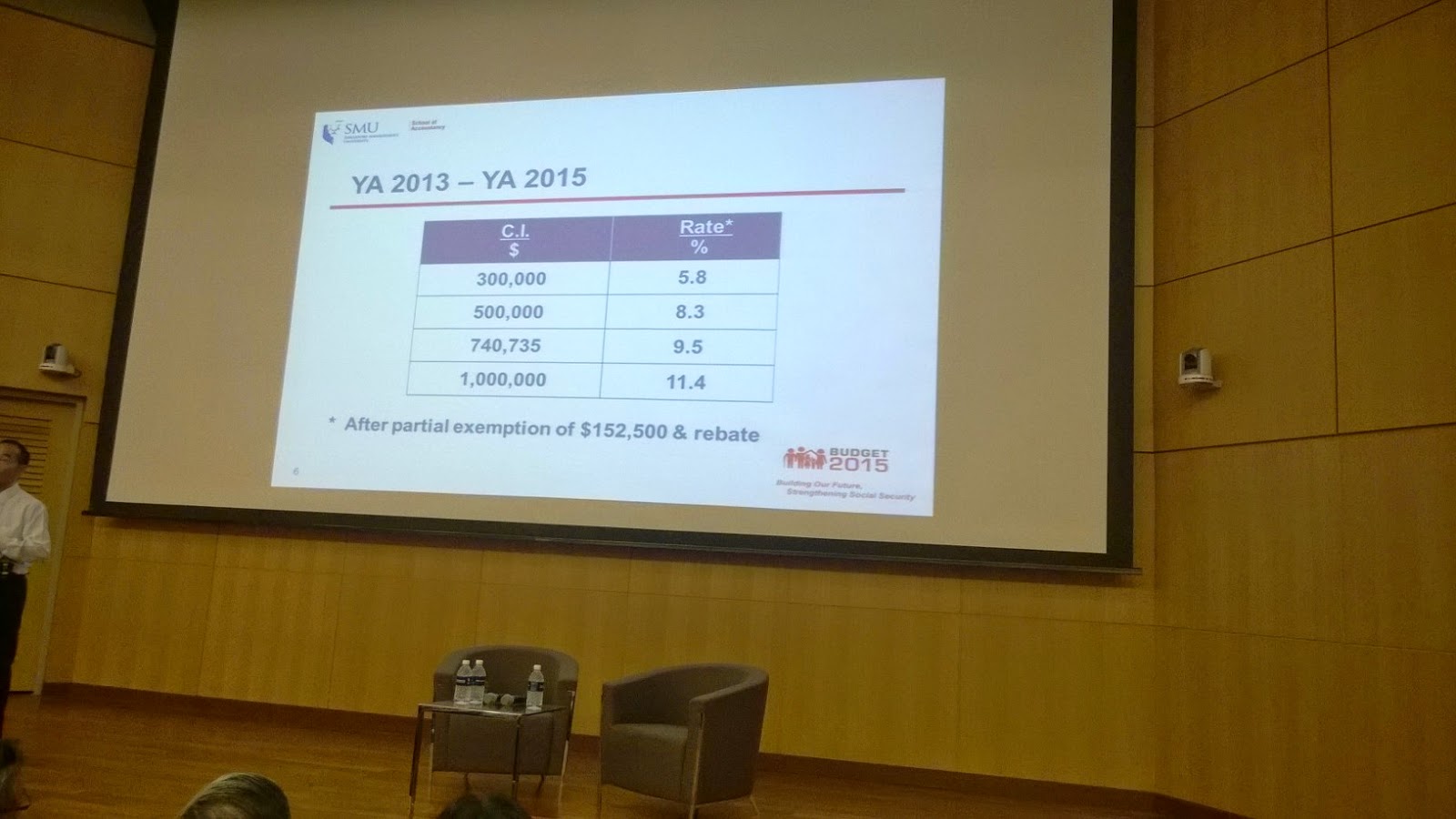
Comparison of Corporate Tax in Year 2015 & Year 2016 taking into consideration the 30% rebate and cash conversation


PIC Scheme Introduced in 2012

2015 Cash Conversion $700,000

PIC Reconciliation

2015 Cash Conversion $500,000

PIC Reconciliation

2016 Cash Conversion $700,000

PIC Reconciliation

2016 Cash Conversion $500,000
PIC Reconciliation

Personal Tax computation for Assesable Monthly Income of $5000 with 4 months bonus Only pay an effective tax rate of 1.24%

Effective Personal Tax Rate for different countries Singapore only 7.9%

Personal Tax Rate Comparison for 2014 & 2015 The high earner of say $350,000 only pay an extra $2000 in income tax


SUMMARY
In Summary what the above means to Singaporean as an Employee and Businesses as an Employer and the self employed, trades contractor :
For the employee and those below 55 years old and earning less than 26,000 and staying in public housing, will receive the maximum goodies like GSTV and S&C rebates, children school fees waiver, maid levy etc
For those earning $6000 now will also see a sudden increase in their salary though it goes to their CPF
For the elderly poor, finally they are appreciated for their contribution. They will receive $400 to $750 on every 4th month apart from GSTV and bonus payout of $900 These will help them alot.
For the trades contractor, real-estate agents, taxi drivers etc, the increase in petrol will impact their earning further. This group will suffer more as the market is already sluggish.
For SME this will translate to increase in operation and HR cost in the already tough competitive slowing market situation now, this will cause them to prefer employing more foreign talents or those in the 20s and of salary less than $5000.
For MNC the operation and HR cost will increase, profit further dampen with the already slowing economy
For civil servants, the increase in cost in their operation and HR budget will mean they need to take more from the tax payers money to fund the increase.
For majority of Singaporean this budget is nothing to cheer about. In fact we will see an increase in cost of living as cost will pass down to consumers
Refer to the below article extracted from http://mothership.sg/2015/02/everything-you-need-to-know-about-dpm-tharmans-budget-speech-2015-in-90-seconds/
Deputy Prime Minister and Finance Minister Tharman Shanmugaratnam delivered the Budget statement 2015 “Building our Future, Strengthening Social Security” at 3.30pm in Parliament.
The Budget is expected to record a deficit of $0.1 billion for FY2014, smaller than estimated $1.2 billion mainly due to increase in motor-related revenues.
Budget 2015 is focused on building Singapore’s future. It takes major steps in four areas (see graphic from Ministry of Finance below):

Key Points of DPM’s Budget Statement:
1. What is SkillsFuture? It will help Singaporeans with their lifelong learning, through internship programmes, education credits and career guidance.

2) Skills Future Credit : All Singaporeans aged 25 and above will receive an initial credit of $500 for work skills-related courses from 2016. There will be an online resource for a one-stop education, training and career guidance.

Beyond the SkillsFuture Credit, the Government will support Singaporeans seeking to develop skills in particular fields through the three initiatives: SkillsFuture Study Awards, SkillsFuture Fellowships and the SkillsFuture Leadership Development Initiative.
Continuing the restructuring of Singapore’s economy:
i) The Transition Support Package (TSP): To give businesses more time to adjust to rising costs as they restructure, with TSP being phased out gradually.
It has three parts: the Wage Credit Scheme (WCS), Corporate Income Tax (CIT) Rebate, and the Productivity and Innovation Credit Bonus (PIC Bonus).


ii). Managing the foreign workforce growth: The Government will defer this year’s round of announced levy increases for every sector, for S Pass and Work Permit Holders. Foreign workforce growth, excluding Construction, has slowed significantly from 60,000 in 2011 to just over 16,000 in 2014. In construction, foreign worker growth in 2014 was around 10,000, far below that recorded in the previous two years.
3. Assurance in retirement: There are two sets of measures to strengthen savings and income in retirement – enhancements to the CPF system and the introduction of the Silver Support Scheme (SSS).
i) Enhancements to CPF system: i) Increase CPF Salary ceiling to $6,000 from 2016; ii) Raise CPF Contribution Rates for older workers; and iii) Extra CPF interest for all CPF members 55 & above.
ii) Silver Support Scheme (see below)

4. Help for Education: i) Account top-ups for young S’poreans; ii) Full fee wavier for exams (PSLE, ‘N’, ‘O’ & ‘A’ level exams, poly and ITE exams; and iii) Support for Needy students – additional $6 million grant to self-help groups
5. Help for Households: i) Foreign Domestic Worker Concessionary Levy reduced to $60 per month; ii) GST Vouchers; and iii) One-off rebate for Service & Conservancy Charges.
6. Foster a spirit of giving: i) Government will donate $20,000 to each school to use for the causes that they identify. This initiative will be extended to Polytechnics and ITE, for which the Government will donate $150,000 and $250,000 respectively; and ii) Government will increase tax deduction rate to 300% for 2015 for donations.
7. Vehicle-related taxes: i) Increase in Petrol Duty rates by $0.15/$0.20 per litre from 23 Feb 2015; and ii) One-year Road Tax rebate
8. Personal Income Tax (PIT): i) Increase top marginal tax rate from 20% to 22% for chargeable income above $320,000 and ii) Increase marginal tax rates for chargeable incomes above $160,000 to $320,000 by 1 to 2%.
Subscribe to:
Posts (Atom)