Reflections: The purpose and the context of an assessment and the consultation with stakeholders
Assessment plan provides a guideline for facilitator to conduct assessment on learners. It contains all the details about the assessment, including assessment methods to be used, evidence to be collected, specifications for each assessment method, and documentation of assessment record. Prior to the actual conduct of the assessment using assessment plan, it is important for the assessor to clarify and confirm details of the assessment plan with relevant stakeholders.
The relevant stakeholders may include training manager, human resource manager, candidate’s superior. I have two details of the assessment plan to confirm with the stakeholders:
• To confirm with Human Resource Manager:
1. Organisational environment/ resources: Providing the organization’s SOP, policies and guidelines for training and curriculum development purpose
2. Assessment specifications on Special needs: HR will be able to inform us of any special needs requirements
• To confirm with training manager
Venue and date
1. The venue (We will arrange someone to bring you to the venue. A visit to the venue before the assessment is possible and can be arranged if required)
2. The assessment room (The company will provide an assessment room)
3. The holding area (The candidates can wait at the pantry at our company)
4. The date of assessment and alternate dates, if necessary
Purpose of assessment
1. To access candidate competent in this certificate course on “Sell Products & Services”. Also to identify for any gaps or her readiness for next level of career progression.
Context of assessment
1. To carry out according to company SOP and practises, industry standards and regulations
Resources, props and equipment
1. Who is the person-in-charge of providing the props and equipment for the assessment? (Our staff will set up the props and venue)
2. Who is in-charge of printing the assessment tools (We will print all the assessment records for role play and oral questioning, the assessment summary record; the role play scenario and logistic checklist. We will give you the assessment plan 1 week in advance to clarify with me - the training manager)
3. The Store Standard Operating Procedures (SOP), Matrix of Assessment methods, Pre-assessment instructions for both assessor and candidates will be given to you 1 week before the assessment
4. I will give you my assistant’s contact number for the support you may require
Candidates
1. Learners’ profile including their mobile numbers (Can be found in the assessment plan. No special needs required. Candidates will dress in uniform for the assessment)
2. Food and drinks are available at the company pantry
Assessment Outcomes
1. My training dept will get the result from you
2. Finance will liaise with you on payment
(N.B. The bracketed notes were presumed given by the manager)
Entry 9 - Prepare assessment venue and resources in accordance with assessment plan and safety and health requirements
Video of conducting a check on the logistic checklist
Logistic Checklist Time in video
Checking the venue and resources 0:00.53-0:01.53
Picture of Assessment Logistics checklist on Day 1


It is essential to prepare assessment venue and resources a day before the assessment. We did not use winter wear in our assessment role play. We use ladies blouses and replicating tools as close to a real shop as a valid scenario. I use PowerPoint to create the shop-front with BEBE shop signage and some display of blouses on mannequin at shop-front. The inside of the shop, we use the whiteboard as a backdrop to hang 3 pieces of blouses on hanger with price tag on each blouse.
We also use the entrance door as a fitting room with mirror. We laid the accessories and scarves as complementing items on the table in the centre of shop. The assessor/candidate table & chairs will be placed next to the display table so that we can capture the full scene in the video recording. This is to collect physical evidences apart from written record of evidences. Also to place the assessor/candidate table near to the role play area, the candidate can recall the role play scenario while working on the OQ.
It is a building fire requirement that every occupants including visitors to the building need to be aware of the fire evaluation plan of the building. Candidate/assessor also need to know the contacts of relevant parties in the event of needs. The fire evacuation plan and contacts are placed prominently near the entry/exit of the assessment room.
Based on the logistic checklist given, we, individually, checked off the items listed to ensure that the venue and necessary resources are ready for the conduct of the assessment.
The picture below show that the venue and resources are well prepared according to the assessment plan and safety & health requirement. (the fire escape route plan and contact numbers are put up on the wall near the main door)
BEBE SHOP SETUP PLAN ON DAY 1
Picture of room setup, resources


My reflection:
Self-Review : We take some thoughts and time in preparing the setup so that it simulate closely to the assessment plan. We also thought that creating a closely related atmosphere would add impetus to learning.
Facilitator Review : The assessment venue and logistics are properly setup and checked.
Entry 10a Prepare candidate for assessment.
Video of conducting a pre-assessment briefing
Pre-assessment briefing Time in video :00.53-0:02.5
I prepared my candidate for assessment by conducting pre-assessment briefing. To do that, I created a briefing checklist script to ensure that I cover all the details of the briefing given in AP. Below is the picture of the briefing checklist.
Picture of completed and ticked Candidate Pre-Assessment Briefing Checklist on day 1
For the pre-assessment briefing, I welcomed the candidate, introduced myself and invited the candidate to sit down. To put the candidate at ease, I engage in small talk, like “how are you today; are you prepared” After that, I checked the candidate’s IC and verified the candidate’s name and IC number.
The pre-assessment briefing is to prepare the candidate on what she will be going through in this whole assessment process. Thus I need to explain the following:
1. Purpose - the assessment is to access her for the qualification in this competency unit of Sell Products and Services with a focus on two competency elements; establish customer requirements and recommend products and services. Also to check her learning progress with a view for career progression.
2. Context - Assessment is conducted in the context of BEBE Company SOP and industry practises. Checked that the SOP was made known to her during the training.
3. Process - inform the candidate that she will be assessed on the 4 PCs and 5 UKs given in the AP through role play and oral questioning. The duration of role play is 15 minutes and OQ is 15minutes. The procedure of the assessment are also clearly explained to the candidate.
4. Appeal - In the event that candidate is assessed “NYC”, and if she has any dispute on the assessment outcome, she has rights to appeal in writing within 7 days with a payment of $30.
5. Clarification & Special needs - To make sure that candidate is well prepared for the assessment, I tried to seek feedback on candidate’s understanding of the assessment and asked if she has any special needs so as to make allowable adjustments.
My reflection:
Self-Review : I had prepared a script and placed in-front of me to refer to so that I would covered all points in the briefing. I took a conscious effort in doing this part of assessment properly and indeed went smoothly without replay.
Facilitator Review : Brief candidate according to checklist, role-play about 15 minutes and Oral questioning about 15 minutes. Assessor showed concern to the candidate by putting her at ease before beginning assessment. Also checked-in with candidate to make sure she is ready before beginning the assessment.
Entry 10b - Conduct assessment in accordance with an assessment plan.
10b1. Conducting the Assessment
Video of conducting assessment showing all the components of the assessment plan.
Video on Role-play for C case
Video on Oral Questioning for C case
Reflection on how I have met the requirement of Conducting the Assessment
The assessment was conducted according to the assessment plan. During the briefing, I showed the candidate the role play script, then went through the props with her and encouraged her to seek clarification. During the role play, I carefully observed the candidate’s performance and noted the areas where the candidate was “Competent” and “Not Yet Competent”. When the assessment was done, I gave a clear and constructive feedback to the candidate, and sought agreement with the candidate on the outcome.
During the oral questioning, I asked the given questions under UK and listened carefully to the candidate’s answers to the questions and recorded the evidence down against the criteria stated in the assessment plan. After making assessment decision, I gave feedback to the candidate and sought agreement with the candidate on the assessment outcome. I also reminded the candidate of the appeal rights and procedures.
The time for both role play and oral questioning were well managed. The role play took about 15 minutes and the oral questioning was done within 15 minutes.
Self Review : I followed closely to the assessment plan, understanding the framework, the competency category and the unit I will be focusing on. Fully aware of the assessment methods I will be using to cover the two elements of competency and making sure that throughout the role play and OQ, candidate is able to fulfil all the Performance criteria. Also making sure all evidences are recorded in writing and captured on video.
The assessment also mirrors real-life contexts as it follows closely to company SOP and industry standards equipping them with practical and useful skills, and addresses skills that are relevant and applicable to their job.
Gaps that need to be covered
– Being able to put the candidate at ease and checking that the candidate is ready. However, I would have briefed the candidate on the process of the oral questioning.
– I was prepared for the assessment and was familiar with the assessment process hence, could act with calmness throughout. However the area I need to improve in the future is that I need to display an air of calmness and confidence when conducting assessment, especially during giving feedback. I was too quick to point out their mistakes and shortfall, as a result creating some tension as people tends to be reactive to negative comments.
– As he was arguing and hoping to recover the NYC outcome, I handled the case sensitively and objectively. I told him if there is any differences between company standard and SSG standard, I will feedback to SSG and I advised him to highlight to his company. He was later being more receptive of the NYC outcome and mentioned that he would like to appeal.
- In the replay of OQ, upon reflection of my mistake, I started by telling candidate on the part he did well first, then followed on the parts he did not fulfilled the criteria by giving reasons.
– My time management for the assessments were good and on time with all the records correctly filled and signed off during the replay.
– I should give feedbacks for both the RP and OQ at the end of the assessment (this had been adjusted for the NYC case).
– I asked the candidate to sign off for the assessment for the NYC case, even though he mentioned he wanted to appeal. (this had been adjusted during the replay for the NYC case.)
– I also overlooked on studying the learner’s profile, so that I can adjust to their profile and treating each candidate as individual.
Facilitator’s Review :
I demonstrated an air of control and calmness throughout the assessment. Managed the process with firm words. Able to proceed on a step by step manner following the assessment content. Provided opportunities for candidate to display competence and asked good follow up questions. Assessment records are completely filled with comments and examples against the PCs and UKs.
Initially acting as a customer, I did not gave candidate the opportunity to demonstrate her competence to match customer’s requirement when customer negotiate for more discount. Facilitator mentioned this gap and I covered it in replay and candidate was able to fulfil this criteria well.
Suggestion for improvement
I realized that minor gaps can filled during the “NYC “ case, but on the “C” case, we were trying to act smart, giving comments and telling our team mates what went wrong. This has caused some tensions and unhappiness. For example in the “C” case, I did not hold the report sheet to record evidences during RP, but I was holding my script. My team commented so strongly that I needed to do a replay. I did and later facilitator told me a major gap on negotiating for discount was not acted and I needed to do another replay again. I was initially annoyed but carried on to complete this assignment with the team. On my part I also committed the same mistake to my team but I did told them those gaps are not important.
Facilitator would have cautioned us on this problem and advice us not to give unnecessary comments on our team but let him assessed us, as I noticed facilitator was only focused on the key part of assessment plan to assess us, letting go minor gaps.
In this episode, it tells me most learners are structured in our learning, not flexible and not able to see the bigger picture, supposedly due to our early education system.
We are trained to be facilitator for adult learners and if we are not adaptable in facilitating and assessing, we will fail because adult learners can be stubborn, unwilling to unlearn or lack the academicals education as some have not even completed GCE “O” level.
What I would have done in future assessment assignments
- I would study the AP thoroughly and focus on the key requirements.
- I would prepare AP process checklist e.g. ticking AP process checklist (e.g. pre-assessment briefing, RP, OQ, Feedback, Appeal procedure, Signing etc) to ensure I cover all the AP process.
- I would prepare the key PCs to cover e.g. RP checklist ( write down key PCs to cover and tick during the role play acting.)
- I would study the learner’s profile and adapt my communication and interpersonal skill during the RP & OQ assessment according to candidate profile, treating each candidate as individual.
10b2. Making the assessment decision
Evidence of Record showing assessment decision “C” on all PCs & UKs


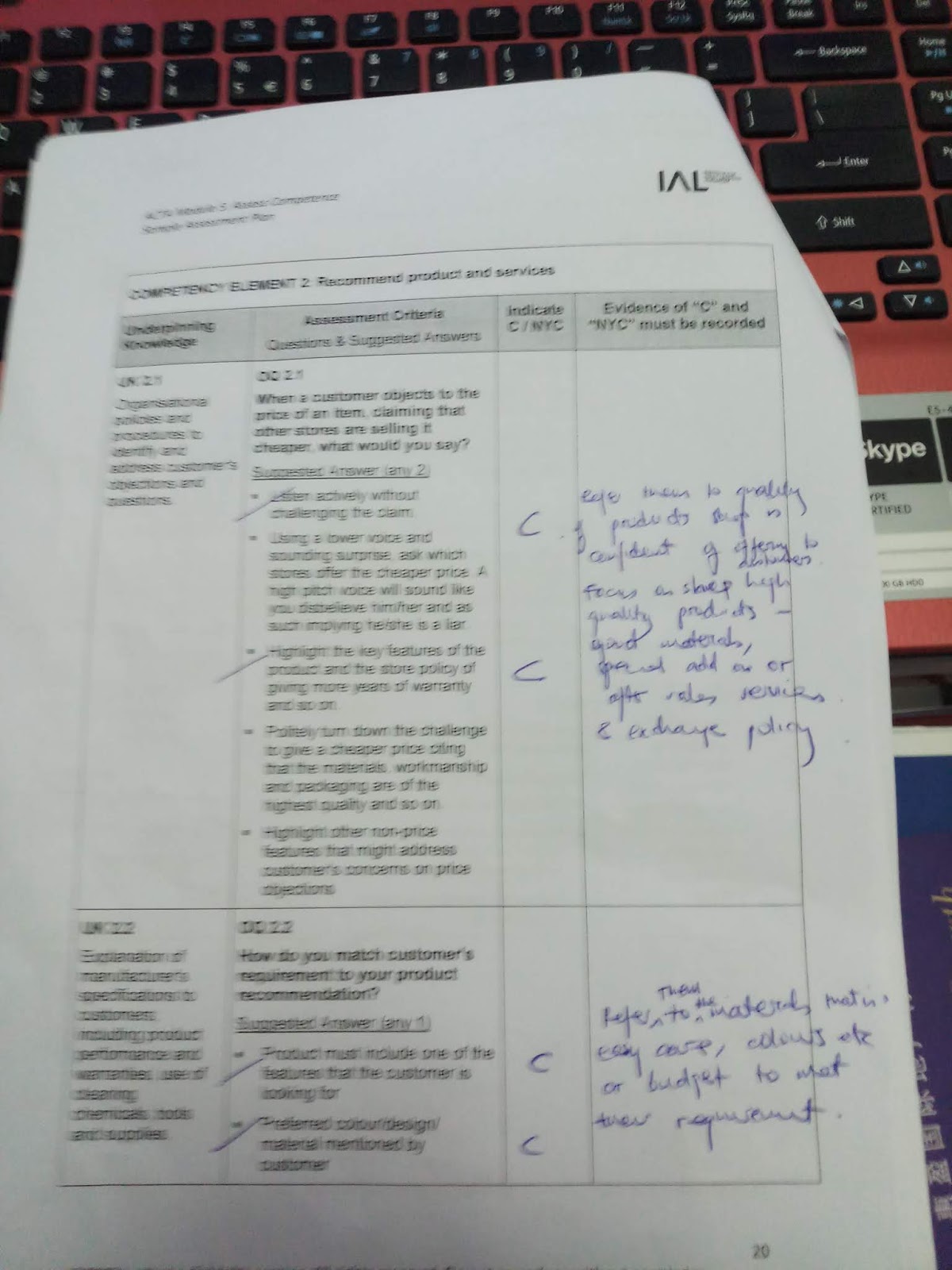


I have applied all the principles of assessment and rules of evidence in justifying my assessment decision for “C” assessments
Assessment decision for ‘C’ Decision and justification
Principles of Assessment Justification
Validity The assessment was based on the company’s SOP and more than one method of assessment was used as a basis for judgment. This made the assessment a valid test of the required skills, knowledge, and attitude.
Reliability Specific demonstrated knowledge, skill and ability specified for the performance criteria were displayed by the candidate
The assessment plan provided a clear guidelines, which allowed me to make consistent decisions.
Fairness All candidates are based on standard framework document to assess for competency.
The instructions given to candidates covered all the assessment process, feedback, and appeal process. This made the assessment transparent and fair to all the candidates.
Flexibility Allowing the assessment to be conducted at a mutually convenient time and place of candidate
The assessment was contextualized in accordance with the company’s SOP and the venue for role play was set up as a retail outlet of the company. This flexibility allowed the assessment to be adapted to meet the needs of all candidates.
Rules of Evidence Justification
Valid Evidence The evidence is valid because it meets the competency standard and assessment criteria specified in the assessment plan.
Authentic Evidence The evidence I gathered is direct and authentic. It is the candidate’s actual performance during role pay and answers given during oral questioning.
Sufficient Evidence Candidate demonstrated the knowledge, skill and ability and met all the assessment criteria for PC1.1 – 1.4, PC2.1 – 2.4, UK1.1 – 1.2, UK2.1 – 2.3 and UK1.1-1.2 & UK2.1-2.3
Current Evidence Evidence was collected and recorded during the assessment.
The evidences gathered through role play and oral questioning reflects the candidates’ current knowledge, skill and ability required for the job
Entry 10b3b – Providing Feedback to candidate For “C” Decision
I clearly cited some specific examples of what she did well. When giving feedback, I cited the observation that the candidate was able to demonstrate well in matching customer’s requirement in style and budget. Though customer bargained for a better price, she was able to draw customer to alternative items that are add-ons at a bargain, eventually convincing customer to pay the blouse at store price. Able to suit to customer’s needs by displaying flexibility e.g. offering fashion advice on matching accessories to attire. She also highlighted a selling point – mentioned that the products are individually tailored and of high quality material. One area for improvement is she can slow down her pace of explanation and give customer some space and pace, otherwise she may come across as being too pushy.
All specific PCs and UKs are fulfilled.
Feedback on “C” result
Self Review : I followed closely to the specific performance criteria, checking that candidate is able to fulfil all the Performance criteria and making sure all evidences are recorded in writing and captured on video.
Facilitator’s Review :
My feedback is well balanced mentioning strength and suggestion for improvement I provided accurate description of the evidences. Overall I control the process well and was patient with the candidate. All documents are signed.
Evidence of Record showing assessment decision “NYC” on all PCs & UKs
Entry 10b2a – Assessment for ‘NYC’ Decision and justification
Evidence of Record showing assessment decision “NYC” on PCs & UKs


I have applied all the principles of assessment and rules of evidence in justifying my assessment decision for “NYC” assessments
Principles of Assessment Justification
Validity More than one method of assessment was used as a basis for judgment
Reliability Specific demonstrated knowledge, skill and ability specified for the performance criteria were displayed by the candidate
Fairness There is a clear appeal procedure for the assessment processes and decision and candidates were informed prior to the assessment
Flexibility Allowing the assessment to be conducted at a mutually convenient time
Rules of Evidence Justification
Valid Evidence The evidence is valid because it is based on the competency standard and assessment criteria specified in the assessment plan to assess C or NYC
Authentic Evidence The assessment is carried out face to face with assessor and at the workplace.
Sufficient Evidence Role play – Candidate did not demonstrate the specific knowledge, skill and ability for PC1.2 & PC2.1-2.3. He wasn’t showing initiative to probe and ask more question to find out the customer’s needs and did not present the full features of products well
Current Evidence Evidence was collected and recorded during the assessment.
Entry 10b3b – Providing Feedback to candidate For “NYC” Decision
I clearly cited some specific examples of what he did well and what he could improve on. My feedback to him were, he displayed good etiquette and good manner of a sales assistant, well groomed, confident in interacting with customer, able to establish good rapport with customer. However he was not able to draw out customer’s wants & needs by asking more probing questions, only ask for customer’s budget and focusing on selling the store high seller item..
He also would not present the full features and benefits to customer so that customer can have more choices to make a prompt decision. However he highlighted a selling point – mentioned that the products are individually tailored and of high quality material
Room for improvement - He should speak a little louder and since he is new, he should use the opportunity to learn more of the company’s products, speak more and not be afraid to fail. Usually inexperienced staffs are always having dilemmas on whether they are doing right or wrong by certain actions or words. But if new and not willing to step out to learn, will never learn. Learning through experience is more authentic than going to school to load with lots of theory.
Specific PCs that were not fulfilled – PC1.2 & PC2.1-2.3.
I had provided feedback in a clear and constructive manner (at least 2 examples)
I balanced my feedback with good comments followed by room for improvement to encourage the candidate to improve and continue learning (in the NYC replay)
I make sure that my feedback is not only constructive but performance based relating directing to specific criteria for the two competency elements.
• Constructive feedback is information-specific, and based on observations.
• Direct and sincere when delivering the message. Both negative and positive feedback should be given in a straightforward manner.
Self Review : Gaps I need to improve on is:
I did tried to maintain eye contact with candidate occasionally but not throughout the RP and OQ. I was too conscious on the PCs and OQs on the AP I am holding on hand to fulfill as I need to multi-task between asking (as an accessor)/acting (as a customer)/writing down the evidences. I would have focus on the process of assessing him on the PC and OQ first and write down briefly the evidences collected. I can then write in greater details on the evidences collected after the RP and OQ.
– I was too negative and quick to point out their mistakes at first that causes candidate to be very reactive, making the process more difficult for me but I improved on it during replay. I should emphasize on what he had done well first, then explained in a positive tone what he would have done better.
I realized that improving on the way I speak is important as communication and inter-personal skill play an important part of being a good facilitator and assessor.
Peer Review : Room for improvement is on my feedback skills – the “sandwich approach” of positive and room for improvement to be in positive instead of negative tone and words. I need to be giving more specific examples for improvement.
Facilitator’s Review :
My feedback is well balanced mentioning strength and suggestion for improvement I provided accurate description of the evidences. Overall I control the process well and was patient with the candidate.
10b4. Applying Communication and interpersonal skills
Applying features of effective communication and interpersonal skills while conducting the assessment for “C” & “NYC” Decision
NYC & C case on Pre-assessment briefing;
RP & OQ Time in video :00.002-0:05; 00.005-0.13; 00.003-0.15
Reflections:
Interpersonal and communication skill is one of the core skill and expertise that assessor needs to have in order to be competent. A good interpersonal skills will help assessor to be able to communicate effectively with learners. This will also helps to build rapport and establish a trusting relationship with learners - not only so that they can perform optimally during an assessment, but also able to trust the assessor to have their interests at heart.
Good interpersonal and communication skill will help candidate to feel that the assessment is fair, the assessor acts with integrity and confidentiality and the assessment is conducted according to the principles of a good assessment.
Application
I tried to apply effective communication and interpersonal skills when conducting the assessment.
1. I tried to process and interpret both verbal and nonverbal information from candidates and to respond appropriately; for example I listened when candidate speaks. I look for non-verbal communication. Asserting myself when the candidate was distracted in talking non-stop without a pause during the role play. I also tried my best to convey information using non-verbal messages such as facial expressions e.g. looking at candidate for hint before I proceed further, tone of voice and gestures e.g. smile or affirmation.
2. I tried to select key pieces of a complex idea to express in words that is able to build shared understanding; for example during the NYC case, I provided a shared understanding that we both will feedback to higher authority regarding candidate’s dispute on NYC on specific item, and at the same time explaining the appeal procedure he would take. In this way I was negotiating for a mutual good closure.
3. I negotiate for positive outcomes with candidates through social perceptiveness, instructing and orientation; for example I started by engaging the candidate in small talk so as to prepare the candidate at ease and check for special needs. I tried to maintain eye-contact with candidate and nodded head when the candidate was giving answers to the questions. I checked for understanding when conducting the assessment. Last but not least, I always checked for understanding before start of each assessment.
4. I pursue clear definition with clarity on the whole progress towards developing assessments of them. For example I applied “goal-directed” behaviors to help candidate feel confident that the assessor can manage the assessment process such as familiarity with the standards being assessed, knowledge of current practices associated with the role against which performance is being assessed.
5. I tried to adapt to learners’ profile; for example treating each candidate as an individual and interacting at their level of understanding
Facilitator’s Review : I showed concern to the candidate and put the candidate at ease
Entry 10c: Application of Code of Ethics of Assessor (2), Professional Values (2), and professional de-manor
Application of Code of Ethics:
NYC case video on OQ Time in video :00.12-0:015
• The candidate is made aware of rights and processes of appeal at the
beginning of both the C and NYC assessment. I also briefed them that the appeal process will be made known to them if the outcome of the assessment is NYC. During the NYC assessment, after I had announced to the candidate that the outcome was NYC, I briefed him on his rights for appeal and its process.
C case video on RP Time in video :00.002-0:015
• The assessment decisions were based solely on authentic, valid, sufficient and current evidences. The evidences collected during both C and NYC assessment were recorded during the assessment. The evidences are verified with the suggested answers and the performance criteria before deciding on the competency of the candidate. The candidates were verified to be the correct candidates and the requirements for the whole assessment process, its context and purpose of the assessment were made known to them during the pre-assessment briefing. The evidence collected is related to the criteria indicated in the AP in order to be consistent and is reliable.
Application of Professional Value:
NYC case video on OQ Time in video :00.12-0:015
• Principles: I sought clarification on the assessment plan from the stakeholders, gave clear and relevant information to the candidates, informed the candidates of the rights and process of appeal, conducted the assessment in accordance with the assessment plan, recorded the evidence accurately, making assessment decisions based on observations and evidences, and giving the candidate clear and constructive feedback on the assessment outcomes. The whole assessment was made transparent, fair, and objective.
NYC & C case on Pre-assessment briefing Time in video :00.002-0:05
• Awareness: I set up the venue with consideration for building’s safety and health requirements, making known to candidates on the fire evacuation plan and contacts posted on the wall. I also checked with candidates for their special needs and readiness for assessment. I gave clear instructions to ensure that the candidates were fully understood what they needed to do for the assessment.
Application of Professional De-manor:
NYC & C case on RP & OQ Time in video :00.002-0:05; 00.005-0.15
• I consciously ensure that I am impartial at all times and that no discrimination or whatsoever is displayed against the candidates.
• I tried to be professional, acting controlled and polite at all times, by building rapport with candidate right from the start; e.g. greeting and engaged in small talks with the candidate.
• Tried to be aware of candidate’s needs by looking for verbal and non-verbal expression by maintaining eye contact with the candidate throughout the session.
• Giving space and pace for the candidate to respond in the RP and OQ
Self review : I am basically a principled and impartial person by nature. Upholding those ethical values as a facilitator and assessor is not a problem to me but applying it in area of communicating clearly in facilitating and assessing is a challenge to me and I need to improve on it.
Peer review : invite Tang Tung San comment in eportfolio
Facilitator review – firm and consistent and also patient and calm in managing the process.
Entry 11: Any shortfall or mistakes in assessment record documents
Assessment Records on C & NYC cases
Reflection:
For my “C” case, I failed to read the instructions properly – I did not mark a tick to the selected answer candidate had chosen for each item – facilitator highlighted this mistake and I make the corrections.
For “NYC” case, I made a conscious effort to ensure all areas are filled in during the OQ. It was quite a challenge to do the questioning, listening and writing down and yet I have to ensure that I was writing down the evidences correctly. The explaining of NYC case during the feedback was also a challenge as I had to deliberate between my thoughts and words, making sure that I am tempering my feedback in an encouraging and yet factual so that candidate can accept the NYC case. Nonetheless, there was some argument, and I was impatient to explain further. In the replay, I gave a better explanation and told him he had the right to appeal.
During the role play, I only recorded the evidences after the actions were completed. I would have highlight any missing action, placed a question mark beside the item, for further clarification during the oral recovery stage. The missing evidences due to the missing action and clarification are written down as remarks on the assessment record sheet. If there is sufficient evidence for a PC, a tick in the ‘C’ column is given. If there are gaps, a tick in the ‘NYC’ column is given.
Entry 12: Recommend one area of improvement in assessment plan
Suggestion for improvement
Assessment Performance criteria can be more specific more observable so that it is more reliable and with consistency. This is in line with the principle of assessment on reliability.
Example of OQ that can be improved further
Picture on that PC criteria page item
OQ 1.1b Suggested Answer can be – Instead of going up to her and starts talking by clouding her with suggestions, it may be better to politely go to her but stand close by and wait for customer to ask first. This is the best approach as usually customers know what they want and need quiet time to decide. By talking or some sales assistant tends to be too eager to sell once they starts talking first. This is a good sales tactics in giving customers space and pace to decide on an item. Some customers may be annoyed by sales assistant non stop recommending and walk out of shop
These are suggested areas where the Assessment Plan can be improved further :
The role play script should be prepared by the assessor based on the context of the area or industry he has experience in instead of just one scenario to follow. The PC in the standard document is a good guide and sufficient base for assessor to prepare the role play script. If assessor is from the industry he is in, he will be able to conduct probing skills more effectively. Also under Role Play Rules of Evidence, the assessment criteria will be more specific, measurable, observable and contextualize e.g. for the type of product performance feature which the candidate required to demonstrate (contextualize). If it covers ladies blouses, what is the scope of features is he expected to know (specific).
The suggested answers to the OQ in the AP can then be contextualized to the area he is working on. This suggested answers should be provided by assessor.
Digitizing the recording – Handwriting might not be legible for other readers. It will be better to have the assessor input the assessment notes directly into the computer or a tablet. The information can also be captured real-time by the school.
There should be some guidelines on how to close the gap. Different assessors may have different approach in closing the gap or some may not attempt to close the gap
Example of assessment criteria that are more specific, measurable, observable and contextualize as below :
• Lack of assessment on contingency management skills
Role play Assessment Record
1. Item customer requested is out of stock
PCX.X
Follow procedures for sales staff to act
Candidate is able to show all of the following:
1. Note the customer’s request for a particular item that’s not available in store
2. Take down the identity and contact of customer using the control form
3. Record specific item in control form
4. Check the inventory record
5. Call the branch or warehouse for the item
6. Inform customer to comeback to collect the item
• Need for candidates’ elaboration and better phrasing of oral questions
Oral Questioning Assessment Record
PC Underpinning Knowledge Assessment Criteria
2.1 Importance of Procedure for closing sales Question #1
Give 1 reason why it is important to have procedures in place when handling customer in closing sales
Answer may include (any 1) with supporting example:
• Buying pattern of customer are the same
• Customer like to be pampered and respected
• Good service produce happy customer and repeat sales
2.2 Importance of Procedure for customers Services Question #2
Give 1 reason why it is important to lay our clear procedures for staff when serving Customers
Answer may include (any 1) with supporting example:
• To have consistency
• To have standard
• To ensure quality
The contingency management skills such as the one highlighted above helps to allow better validity of the assessment within the organisation’s context.
The assessor can use more probing techniques to inquire whether the underpinning knowledge is really understood by the assessment candidates. This helps in ensuring that the assessment is fair and the criteria for evaluation are clear. Further, it ensures that the evidences collected are sufficient and authentic.
13a Reflecting on M5; area for improvement on assessment delivery
Continuous improvement requires considerable commitment and momentum to
flourish beyond initial successes.
Area for improvement on delivery
• there must be focus and clear objectives e.g. focus on the key requirements in the assessment plan.
• Communication skill is more than speaking skill. It is key to effective delivery for assessor. This is one key area I need strengthened and improved.
• Effort must be made to develop and maintain the involvement of people throughout the organisation in the process. There must be avenue for candidates and assessor to voice our dis-agreement to the AP. Feedback should be studied and effort make to improve on the AP for assessor, learners and stakeholders e.g. Service excellence diploma course, some questions in assessments paper were vague.
• There should be constructive feedback on my assessment delivery from stakeholders, facilitator, peer and self review in order to provide me with the opportunity to assess and identify gaps so that I am make aware of what need to continuously improved.
• Delivery should be assessable or measurearable - whether participants are being sufficiently challenged in achieving their goals and making progression. Are there effective processes and policies in place to review and assess the quality of delivery to the candidate. Or can the quality of the delivery be monitored and evaluated against key performance indicators.
Reflecting on M3; area for improvement on facilitating
Identify Training delivery
Area for improvement on Facilitating
Focus and clear objectives that meet learners profile - Content must not be too long. Lesson plan should be fun, interactive e.g. fun quiz, open question/answer practise session, and then followed by more serious session like group discussion and role play to motivate learners in an active learning environment. Skill in producing good PowerPoint slides is crucial too e.g. background of slides must not be distracting.
Retention and transfer – design to be done in write on stick-note to be pasted on wall and then read it out or get the learners to write it on a notepad and put it in 2 jars. I would then have them picked up and read the answers on the notepad to the class. This method of write and “say it out” is a double reinforcement to retention.
Learners’ prior knowledge – important to take this into consideration when designing lesson plan for different learners’ profile e.g. picture slides may be more suitable for those with no prior knowledge. Pictures are visual and self-explanatory. Video screening need more visual and cognitive skill to process information. The activities must be designed to connect them to recall of experiences or information before diving in to heavier content. This would probably set them on a higher energy and right platform in the activities to achieve the objective.
Ice breaker – is an important part of lesson plan. It is not just to get to know one another but also to energize the learners before training.
Provide more examples and illustrations – for example in the service excellence course that I took, there were 10 modules with 5-6 different trainers. I enjoyed the one that shared their vast experiences in the marketplace which are related to the learning materials. Many thought that they are qualified to teach once completed the Acta class. Our related work experience apart from paper qualification will only make facilitating meaningful and relevant in training
Vary manner, pace or level of facilitation - adjust delivery of lesson in vary manner, pace or level of facilitation to suit learners’ profile e.g. I noticed that in the course, Service Excellence that I attended, the one who was insistent on their way of delivery got the most complaints as learners would not cope. But I enjoyed her class (she is well trained and qualified with Masters). She cannot adapt to learners level. While another also well trained and qualified was able to adapt with interesting class delivery. Most of the trainers with related work experience are good in delivery.
13b Professional goal to match value and ethics
One goal to identify my career progression
My values and ethics will be the guiding principle to achieving my professional goal. My passion and interest will help me make important decision concerning my professional choices.
Some values and ethics I possess include:
Being accountable – I can be entrusted with any assignment, big or small and I will finish it by deadline
Making a difference – I wish to train people to cover skills gaps in my industry.
Delivering quality – always do to my best ability and produce result within expectation
Be straight forward but tactful – show sincerity
Helping others – By lending a hand to help people, it also helps me reach my goal
Being a great team member – I always try to adjust myself and fit in to the team, seeing end result as my goal instead of people
Respecting company policy and rules, and respecting others – I always abide boundaries. Fight not to win but to reconcile differences so that when the goal is achieved, I received my rewards too.
Showing tolerance – patience is key to solving many inter-personal problems. Identify and respect others' values and organizational values
The constant changes in the labour market will continuously make new demands on the skills and adaptability of workers. Participation in adult education and continuing training helps workers to upgrade and adapt to the labour market throughout their lives. The competitiveness of and the quality of services is placing a need on investment in continuing training and competence development. Everyone including those with lowest level of formal education and training, should be given a chance for career progression.
Being in the workforce for more than 30 years, I hope to contribute to learning and developing workplaces to a greater degree and to help strengthen the service excellence attitude in every workers today irrespective of jobs they do.
I have laid down the following goals for myself in adult education and continuing training:
• Everyone should engage in lifelong learning.
• Adult education and continuing training efforts must be effective and flexible. They must not only support good job opportunities for individuals but to do their job with pride and service excellence so that all will benefit, be it stakeholder, consumers or industry and company.
• Adult education and continuing training must provide everyone with opportunities to improve competences - not least those with the lowest level of formal education.
• Adult education and continuing training must reflect changes in the qualification requirements and needs of the labour market.
Self Review : I have many personal goals and passions. I think I have attained certain accomplishment in my profession having been in the same profession for more than 30 years. But others are still in midst of perfecting; e.g. trading forex and international indices which I wish to be a trainer in trading in the future. I also love painting and culinary cooking, may take advantage of SSG subsidy now to pursue these interests.
Peer Review : Goal setter, set goals and complete on time, very focused with end objective in mind; firm, consistent, straightforward, direct, open, honest and helpful; very persistent and insistent in my view
Facilitator Review : I need to exercise patience
13c Identify development Pathway
The following is the action plan I intend to implement for next 6 months after completing ACTA
A career (freelance basis) in training and development can be satisfying. But in order to enjoy and excel at it, I need to develop these competency.
Competencies – facilitating and training
• Communication Skills: Excellent oral and written communication skills are critical in the field of learning and development. I will need to be able to speak in front of large and small groups as well as write effectively for a wide range of audiences.
• Interpersonal Skills: Need to develop good “people skills” and listening skills and able to identify the needs of my audience. It’s also important to be socially perceptive—so that I’m aware of others' reactions and can adjust my message and approach as needed. It is also important to be able to develop constructive working relationships with others.
Level of competencies in training and development tools or curriculum design needed to prepare
• Creative Thinking: able to think creatively to design new programs and approaches to get information across.
• Planning and Attention to Detail: must be capable of putting together detailed plans and materials to support educational programs.
• Technology Skills: must be technologically savvy. All trainers need to know how to use technology in the classroom, as well as how to effectively use learning management systems and online meeting platforms.
Competencies within related job
I am currently a trader and a project consultant in my own field. I will look at these two area of skillset that I have and hope to develop into a training program but it will be for a longer term planning.
With my experience in dealing with diverse culture and groups of professionals, I think I have certain level of people skill and communicating skill. I can listen well, take in information and digest it to give what clients’ want or within expectation.
After completing Acta, I would love to be a facilitator (freelance basis as I still love to do my main job) for WSQ courses like service excellence. Teaching adult learners can be challenging but rewarding and from observation and experience in my class (service excellence class), I am confident I am able to deliver .
In the mean-times, I will work on my gap in the area of competency needed for training and development profession.
14 Adopt one possible tech in training
Online course management systems (CMS) can help realise cost savings by making e-learning work.
Pro in using on-line learning
• expand the range of courses on offer more quickly
• respond to new training demands whenever the needs and innovation arise
• can combine face-to-face mentoring with online learning.
• save costs through reduced travel time and cost.
• Less disruptive to the businesses as compared to traditional face-to-face courses
• facilitate collaboration and knowledge-sharing before, during and after courses such as tools like social networking and web 2.0 applications,
• encourage reflective learning, iterative developments on company projects, implementation of tips and techniques learnt and reinforce information gained in the sessions.
• can involve learners across multiple locations.
Con in using on-line learning
• Initial set-up and ongoing administration of technology tools and resources is costly
• Sophistication of the learning management system and purchasing software packages to allow companies to manage their e-learning is another cost
• Accessibility; and the number of users can be limited
• Open source software has to be managed completely by an end-user organisation or use a third party to provide training, hosting and customisation.
• Need to explore more complex facets of the system and its application to their particular training environment and ongoing support.
Evaluation of EMS
Despite the cost and tech skill needed to incorporate e-learning in training, it is still an essential part of every aspect of work, in every industry that can bring the benefits to staffs, learners from different geographic locality and business profitability. It is a useful tool to trainers and convenience and accessibility to learners.


