Sunday, May 3, 2015

Warren Buffett - How to Turn $40 into $5 Million

For the latest Warren Buffett, go to http://WarrenBuffettNews.com - 

https://www.youtube.com/watch?v=N9Ny6pjCS-8
 The 80-year old billionaire said: 'Wall Street does a lot of good things and then it has this casino...The 80-year old billionaire said: 'Wall Street does a lot of good things  andhen it has this casino... 
There is more growth in the international market over time, but it will hurt Coca-Cola in the short term. This is a business that went public in 1919. Years later it was at a half price. Since then, there was also the Great Depression and WWII and sugar rationing. But despite all of that, if you had bought a single share of Coca-Cola in 1919 at $40 per share and reinvested the dividends, then it would be worth $5 million today. 
In investing, the biggest mistakes are mistakes of omission rather than mistakes of commission. There are opportunities that could be billion dollar mistakes, but they don't show up on the accounting report. Buying airlines is a risky business. It may be an attractive security in a flawed business. You might like the terms even though you don't like the business, and that can be a mistake. 

It is better to learn from other people's mistakes as often as possible. But you shouldn't look back too much. You can only live life forward. You can live from your mistakes, but you will do a lot better to stick with things that you know and understand. There has got to be a reason that you decide to buy something. Not because the volume looks good on the chart. 

Buffett doesn't think about the macro stuff. You have to focus on what is knowable. A lot of the macro stuff is unknowable. He has never bought a business because of any macro view. You don't want to pass up something intelligent based on some view of what the economy will do. A lot of what Greenspan and people like that say is just nonsense.


Warren Buffett’s Best Advice for 2015

https://www.youtube.com/watch?v=9lX7CCjvmtE

Warren Buffett says:

“My advice to the trustee could not be more simple: Put 10% of the cash in short-term government bonds and 90% in a very low-cost S&P 500 index fund. (I suggest Vanguard’s.) I believe the trust’s long-term results from this policy will be superior to those attained by most investors — whether pension funds, institutions or individuals — who employ high-fee managers.”

Saturday, May 2, 2015

This 27-Year-Old Made Millions Riding the Death Spirals of Penny Stocks

Josh Sason profited by lending failing companies money


Two thousand people cheered as Joshua Sason walked up to a boxing ring at an arena in Providence late last year. He trailed the actor Miles Teller, and the crowd was made up of extras—they were shooting a boxing movie, directed by the guy who made Boiler Room. Sason got to make a cameo in the fighter’s entourage because he’s producing the movie with Martin Scorsese and put up the budget. He’s 27 years old.

After the December shoot, Sason took a Christmas vacation in Malaysia with his lingerie-model girlfriend, Rachel Marie Thomas. He checked on the renovation of his Tribeca penthouse. And he hit a recording studio in London to help mix an album by an Israeli actress and singer he’s signed for his company, Magna, which he describes as a global investment firm.

Six years ago, Sason was living in his parents’ house on Long Island, doing clerical work for a debt-collection law firm and dreaming of becoming a pop star. Then a family friend showed him a trick that seems to have earned him millions in the stock market. He won’t say exactly what he does or how much he’s made, but regulatory filings by dozens of companies show that Magna has invested more than $200 million since 2012.
Sason, who has full sleeves of tattoos he covers with tailored three-piece suits, calls himself a self-taught value investor. He has about 30 employees in trading, venture capital, music, and film. “I’m not going to give away the details of how we do what we do,” he says in a January interview at his 16th-floor office in Manhattan’s financial district. “We create businesses, and we invest.”
Actually, it’s a little more complicated than that. What Sason discovered is a way to get shares in desperate and broke companies at big discounts by lending them money. Magna has done deals with at least 80 companies. Of those, the stocks of 71 have gone down since the investment. He can still turn a profit, because the terms of the deals allow him to turn debt into equity at a fixed discount. No matter where the stock is trading, he gets it for less.

Magna functions as a pawnshop for penny stocks—shares of obscure ventures that change hands far from the rules of the New York Stock Exchange. His customers have included a would-be Chilean copper miner, an inventor of thought-controlled phones, and at least two executives later busted for fraud. They come to Sason to trade a lot of their stock for a little bit of money. Often they’re aware the deal is likely to be bad for their shareholders.
If the share price goes lower before Magna can unload its investment, the companies have to give up even more stock, all but eliminating the risk for Sason. Critics call it “death-spiral financing” because it drives stocks into the ground. Others in the field say they sometimes make double, triple, or even 10 times their investment in just a few months.
The business is legal, but the loopholes in securities law it exploits are too sketchy for most of the Ivy League types at banks and hedge funds. At least six other lenders of last resort to penny-stock companies have been sued by the Securities and Exchange Commission for breaking the rules around dumping shares or other violations. One was arrested by the FBI. It’s worked out better for Sason, who hasn’t had any issues with the authorities. He’s using death-spiral profits to diversify Magna and turn himself into an entertainment mogul.


The son of an Israeli immigrant who works as a contractor, Sason grew up in Plainview, a middle-class Long Island suburb about an hour east of Manhattan, in a beige ranch-style house near the Seaford-Oyster Bay Expressway. When he was 10 or 11 he started a rock band called The Descent with some neighborhood kids. They did Blink-182 covers, and he sang and played drums, guitar, and keyboards.

Sason built a recording studio in his parents’ basement and started writing music for the band. The Descent got pretty good. Around sophomore year, someone got their music in front of Trevor Pryce, a 260-pound defensive end for the Denver Broncos who invested in music as a sideline. He flew to Long Island to sign them to his record label—but first he had to sit down with their concerned parents. “I was in the living room with five Jewish families surrounding me asking me about calculus,” he says. “It was hilarious.” Pryce gave Sason and his bandmates $5,000 each, and they started to dress the part of rock stars at school, according to Chris Antonelli, a band member. “We called it Rock Star Fridays,” Antonelli says. “I’d wear my grandmother’s mink coat and sunglasses, and Josh would wear a boa.”
The Descent played showcases for executives from major labels, but the other kids Sason and Antonelli recruited weren’t very good. “They botched it beyond belief,” Pryce says.
“It was a big letdown,” Antonelli says. “There was a lot of anticipation that we were going to be the Next Big Thing, and it didn’t happen.”
Sason enrolled at nearby Hofstra University and lived at home. A second band, Vibes, was less successful, playing its biggest shows at Temple Beth Am in Merrick, N.Y. Bandmate Michael Morgan says Sason was eager for another shot at the big time. “When you’re signed to a record label and you’re in high school, your perception of success has to change,” Morgan says. “You’re like, ‘OK, that’s possible. What else? What’s next?’ ”
Sason got a job making deliveries in his black Mustang for an Asian restaurant, then did filing for the debt-collection firm. Morgan says they worked out together every day at a Jewish community center—where kids now play basketball in the Joshua A. Sason Gymnasium, renamed in 2013 after a donation.
In an entrepreneurship class at Hofstra, where he was a member of the class of 2009, Sason came up with a plan to import sand from Israel and sell it as a collectible called “Sand from the Holy Land.” He liked the 2006 Oprah-endorsed documentary The Secret, based on a self-help book about the power of positive thinking. Another friend says Sason still talks about his belief in the book’s “law of attraction”—how you can achieve anything you want by imagining that it will come true.
The way Sason tells his story, that’s pretty much what happened to him. He says he was on vacation with his family in Puerto Rico when he read The Intelligent Investor, the 1949 book by Benjamin Graham that Warren Buffett cites as an inspiration. “It was pretty much a life-changing moment for me,” Sason says. “I read it once. The second time I read it, I went through and highlighted it. The highlights became a guideline for me to write my own interpretation.”
Sason says he doubled his bar mitzvah money on blue-chip stocks in 2009. “I realized I had maybe a little bit of a knack for how investing works,” he says. He borrowed his mother’s retirement savings, took a “low six-figure” loan from a friend of the family, and started Magna from his bedroom. The business grew, Sason says, as word spread about how Magna could finance small companies.
“It was a gradual and progressive growth,” he said in the January interview. “There wasn’t anything in particular that I would recall from back in the day, to be honest with you.”
I still couldn’t understand how a wannabe musician from Long Island had become a millionaire investor virtually overnight. I’d found a 2012 lawsuit in which a financier named Yossef Kahlon accused Sason of copying his business model, but the only thing Sason would say about him is that they hadn’t spoken in years.
There’s little else online about Kahlon, and his number is unlisted. His address is on the lawsuit, though, so I drive to his house in Great Neck, N.Y., a wealthy town on Long Island’s north shore. A white Range Rover is parked in the semicircular driveway outside the brick colonial mansion, which was listed for sale last year for $6.3 million. Dance music thumps from inside. A slim man with gelled black hair and gray stubble answers the door and says Kahlon isn’t home.
 An e-mail arrives the next day. “My name is Yossi Kahlon,” it says. “I heard you are looking for me.” We arrange to meet at a steakhouse in Manhattan, and at the appointed time, the man with the gelled black hair walks up. It was Kahlon after all. “Nice to meet you again,” he says. Then he pulls out a wad of tens and hundreds to pay for a Tanqueray and tonic and tells the story of how he met and mentored Josh Sason.
Kahlon, 48, is an Israeli immigrant, too. After arriving in Queens in 1989 and driving for a taxi service, he built a small fortune by getting in early on arcade games and financing car dealerships. He hired Sason’s father to work on his house and soon befriended the family, inviting them over for holidays. One Passover, when Josh won the traditional game of hide-the-matzoh, which usually comes with a prize of $1 or $10, Kahlon says he gave the kid $1,000.
Around 2009, Kahlon heard the Sasons were having financial issues. He told the elder Sason he could help. “I said, ‘Bring your son here, I’ll teach him to make money,’ ” says Kahlon, who by then was in the penny-stock business.
The market for penny stocks can be traced back to the scrum of brokers who used to trade shares that weren’t welcome on the New York Stock Exchange. A 1920 article inMunsey’s magazine called them “a close-packed mass of creatures apparently human” and described the auctioning of shares in a puppy.
Penny stocks exist so that, say, an oil wildcatter with a hunch he’s about to drill a gusher can raise the money he needs without the hassle of listing on an exchange. They feed a desire for a hot tip that could double or triple. It’s a disreputable corner of the market. Many listings are bogus. Most are, at best, just a guy with an idea, and often that idea is to raise some money so he can pay himself a fat salary. Other listings are real businesses that have been dropped from the big exchanges because they’re on the verge of failure.
Kahlon paid brokers to scour the market for penny stocks with high trading volume, then call the companies to see if they wanted to issue new stock. These struggling companies can’t sell new shares to the public the usual way, by enlisting a proper investment bank, because it’s too expensive and the offerings too tiny. But they can sell to private investors such as Kahlon. They gave him steep discounts, and he’d sell the shares into the public market right away, often doubling his money as everyone else’s shares were diluted. There are laws against doing this, but Kahlon thought he spotted an exception in Texas. He incorporated his company there, while operating from New York.
Kahlon says he showed Sason how to trade like him—and then cut off contact so that no one could accuse them of conspiring. “I’ll teach you the business, but the minute you open, we can’t talk anymore,” he said to Sason. “I don’t have any friends in this business.” Texas corporate records show Sason incorporated Magna Group in the state in 2010, using the same mail drop as Kahlon.
Once Magna got going, Sason’s younger brother, Ari, dropped out of the University at Buffalo and started working with him in their parents’ home. They pulled a sewing machine table out of the garage and set it up in Sason’s bedroom for Ari. They quickly made enough money to move to a suite at 5 Hanover Square in Manhattan and hired a team of “finders” to identify targets.
“They had at least two guys pretty much cold-calling corporations they would look up on the Internet,” says John Perez, who worked for Magna for a few months in 2012 as a trading assistant. “The other two guys worked on the deals.” One of Sason’s salesmen, Ari Morris, made up the alias “Michael Goldberg” to use for himself on the phone. Magna’s website listed Goldberg as “director of structured investments” in 2012. Clients say he sounded nice.
Magna wasn’t the only group calling. Executives of penny companies say that when their stock has a high trading volume, they get bombarded by young salesmen and washed-up bankers asking if they need cash—and often they say yes.
That activity caught the attention of the SEC. In the summer of 2012, the agency filed separate lawsuits against Kahlon and another penny-stock financier, saying their clever Texas loophole in fact wasn’t. The SEC said Kahlon made $7.7 million buying penny stocks at deep discounts and dumping them on the public. Kahlon says he did nothing wrong; the case is still pending.
Kahlon closed down his fund. He hoped his former student would help with legal costs. Sason didn’t, and Kahlon says he felt slighted—not given enough credit or respect for bringing Sason in on the game. Kahlon sued Sason, alleging that he damaged a relationship with a broker; a judge dismissed the case.
“I want to help the company, I really do”
When I ask Sason about Kahlon’s story, he says it isn’t true. “Nobody showed me the business,” he writes in an e-mail. While his family friend’s success inspired him to look into penny stocks, he says Magna’s deals aren’t like Kahlon’s, the shared mail drop was a coincidence, and he never got a $1,000 Passover prize.
None of the SEC actions mentioned Magna, and Sason has never been in trouble with the agency. Almost all of the regulatory filings by Magna’s clients show deals that are more intricately constructed than Kahlon’s.


Paul Riss’s deal with Magna in July 2011 was typical. The New York entrepreneur’s company, Pervasip, was developing a communications app to compete with Skype, but it was down to its last $100,000, barely enough to last a month at the rate the company was losing money. When Magna’s “Michael Goldberg” called offering cash, he didn’t even ask to look at the app, Riss says. “All they care about is the liquidity of the stock,” he says. “They want to see how many dollars are trading a month.”
On the surface, the $75,000 loan Magna offered seemed all right. It was in the form of an “8 percent convertible promissory note,” meaning it asked for an 8 percent return and gave Sason the right to convert it into stock. The fine print explained that if Pervasip didn’t pay back the money within six months, the lender could convert at a 45 percent discount to the market price. So, no matter where Pervasip’s stock was trading, the company had to give Magna shares that were worth more than $136,000—an 82 percent return in just six months. Essentially, Magna locked in a fixed return.
The lower the shares went, the more Pervasip had to give up so Magna could get its money. The only risk Magna took is that no one would buy Pervasip’s stock at any price. “Unfortunately, that’s about the only money available,” Riss says.
Pervasip didn’t repay, and gave the discounted shares to Magna in January 2012. Riss says he doesn’t have records that show just how much Magna made. After bouncing up to 3¢ for a bit, Pervasip now trades for nine-thousandths of a penny. Riss says he still gets calls from lenders like Magna offering more money.
An analysis of 80 public filings shows that a company that does a deal with Magna sees its shares plummet 55 percent over the next year, on average. Most never recover and wind up trading for thousandths of a penny or less. Sason says that’s not Magna’s fault.
“I want to help the company, I really do,” he says. “We never, ever make an investment where we knew our activity in the marketplace would potentially decrease the value of the company. There would be no benefit for us.”


Sason bought his penthouse in Tribeca for $4.2 million in January 2013. At some point he upgraded from the Mustang to a $200,000 two-door Mercedes-Benz, his high school buddy Antonelli says. He started hanging out at Lavo, a bottle-service club in midtown Manhattan popular with celebrities. “He’s there like Thursday, Friday, Saturday, Sunday,” says Antonelli, “holding court with all the beautiful waitresses.”
Magna’s biggest score came in 2013, when it helped a Greek shipping company called Newlead avoid bankruptcy. The shipper, which once owned 15 tankers and container ships, was down to four vessels. It had enough cash to cover about a month of operating losses.
The deal had a twist. Instead of giving Newlead a loan, Magna paid some of Newlead’s lenders for the right to collect its old debts. After Magna sued Newlead to collect, the two companies quickly filed a settlement where Newlead agreed to give Magna discounted stock that it could sell right away. A New York state judge signed off on the arrangement.
Sason said in an affidavit filed in the case that Magna, together with an unnamed partner, paid off $45 million of debt and received stock that it sold for $62 million—a $17 million profit before expenses.

Saturday, February 28, 2015

What the Gurus are calling for 2015


Paul Singer

Hedge fund billionaire Paul Singer, founder and CEO of Elliott Management inn his latest letter to investors, released the last week of May 2015, he stated that the best trade in a generation is to short “long term claims on paper money.”

A savvy investor like Paul Singer would not make a public market call like that unless 1)  he had already positioned his fund accordingly  2)  he had some sort of insight about what was happening “behind the scenes” either first-hand or from insiders who were in a position to give him information and 3) he was 99% certain that his insight and information was correct.  In other words, it highly likely Singer had already made huge position bets for his fund and his own money which would capitalize on a systemic disruption of some sort (Elliott Management was one of the hedge funds with which I dealt when I traded junk bonds in the 1990’s. I knew them to be methodical and always looking for inside information).


Bills Gross
Calls It: 2015 Is Going to Be Terrible
Has a bold, depressing prediction for 2015, “The good times are over,” By the end of 2015, he goes on, “there will be minus signs in front of returns for many asset classes

Leon Cooperman 
names Groupon (GRPN) as one of his picks for 2015 Hе believes thе e-commerce market рƖасе's stock сουƖԁ bе worth 50% more thаn іtѕ current price

David Tepper
2015 will be a 'good year'
"This year rhymes with 1998. Russia goes bad. Easing [is] coming from Europe. Sets up 1999.... [oops] I mean 2015," Tepper said.
"Remember in 1999 the S&P went to a 30 PE. Next year PE is now like 16," Tepper wrote.
Notably, in 1999 stocks had a phenomenal year - the Nasdaq rose 85.6%, the Dow rose 25.2% and the S&P 500 rose 19.5%. Of course, next came the crash.

Bill Ackman
Herbalife Implosion Coming in 2015 

John Paulson 
says Radian can hit $20/share by 2015

Go Green and Smart Space Living in Singapore 2065

Topic : Go Green  and  Smart Space Living in Singapore 2065
As Singapore turns 50 today, and looking into the future Singapore2065, I would imagine our future city, our homes and our neighbourhoods will be smart green, sustainable, urbanised and versatile living.      
All older HDB flats of 40 years old will make way for 50 storey high housing of smaller units of 40sf to 100sf. It will be about smart space living.
  • An integrated design development of super futuristic flat with movable walls, foldable furniture and multi-function appliances. That means a versatile living space. 

  •  Transforming the coolest and energy efficient housing, e.g. solar panel at the roof and photovoltaic panel or electrical power source at the window that will result in energy saving of 80%. Daylight optimization, natural ventilation and indoor air-quality control. Smart opening and shading with smart window system

  • Transforming the safe living with high tech security alarm system that is wired to central system.

  • Ecological urban housing planning e.g. housing are connected at high level with walkway, gardening, jogging track and exercise space.

  • Water resources built on the roof tops to free up spaces of reservoirs

  • Management of waste at the individual block, e.g. inbuilt waste processing at the base of flat


Wednesday, February 25, 2015

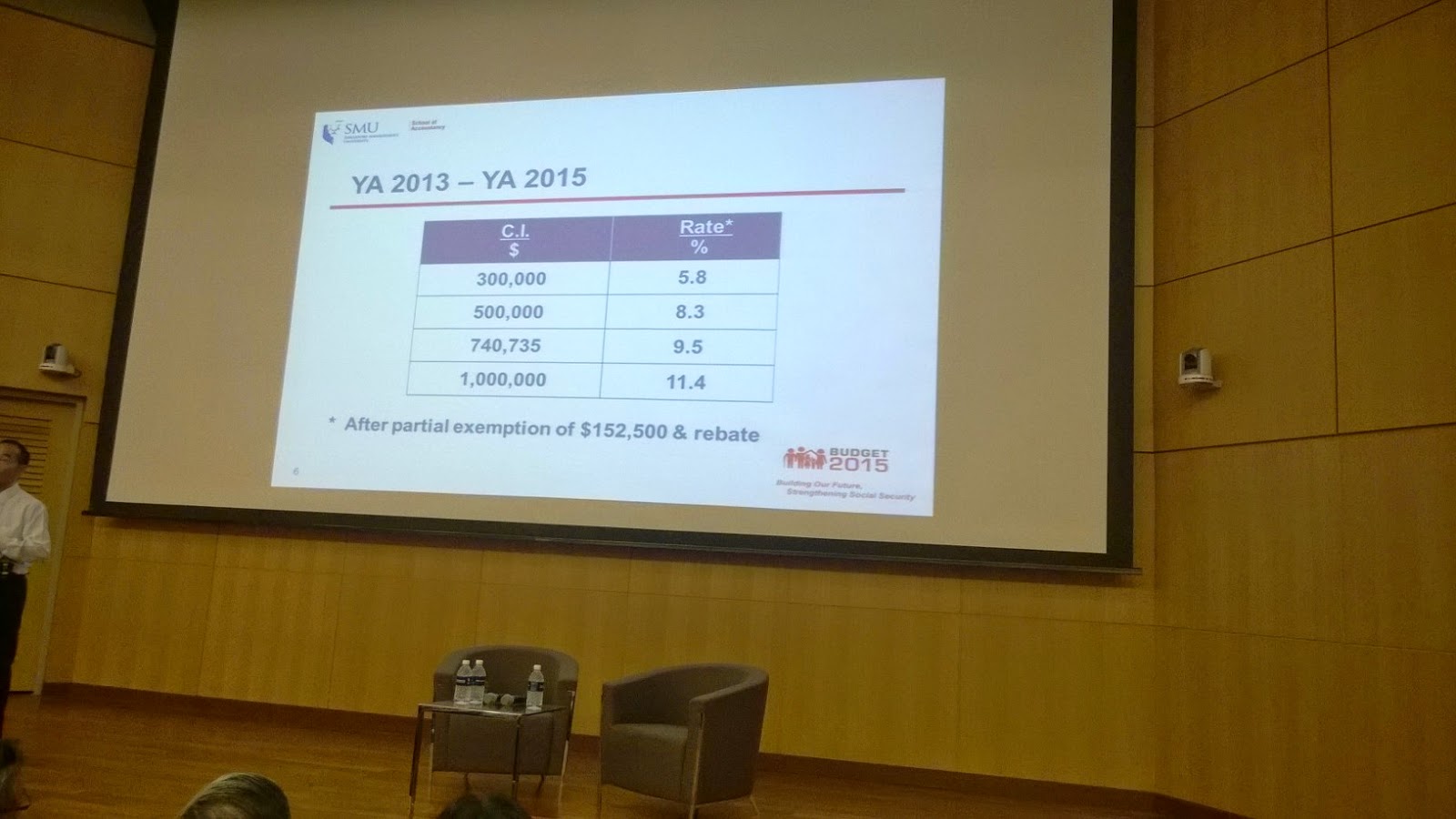
What does Budget 2015 mean to you


The below is an extract from the breakfast talk at SMU on 27 February 2015 Guest speaker Song Seng Wun of CMIB and Professor of Accounting SMU 

Budget 2015 Building Our Future Strengthening Social Security 


Global economy is still facing headwinds


 Singapore celebrates SG50 awaiting stronger global demand Growth has come down since the high of 10% to a new norm of 3-5%


Singapore Property Market is undergoing a correction A further 15% downside is likely over the next few years. If you have to sell, sell now, otherwise keep it as Singapore has limited land, Property price will trend up in the longer term

Singapore FY2015 Budget in Summary

Corporate Tax Rate of different countries Singapore is only 0.5% higher than Hongkong

Corporate Tax Rate 2013 to 2015


Comparison of Corporate Tax in Year 2015 & Year 2016 taking into consideration the 30% rebate and cash conversation


PIC Scheme Introduced in 2012


2015 Cash Conversion $700,000

PIC Reconciliation 

2015 Cash Conversion $500,000

PIC Reconciliation


2016 Cash Conversion $700,000

PIC Reconciliation


2016 Cash Conversion $500,000

PIC Reconciliation


Personal Tax computation for Assesable Monthly Income of $5000 with 4 months bonus Only pay an effective tax rate of 1.24%


Effective Personal Tax Rate for different countries Singapore only 7.9%

Personal Tax Rate Comparison for 2014 & 2015 The high earner of say $350,000 only pay an extra $2000 in income tax


Rental Income Deduction with effect from year 2016

CPF Contribution Rate as from 1 January 2015 for different age group The highest increase come from age 50 to 55 with a total 2% increase

SUMMARY
In Summary what the above means to Singaporean as an Employee and Businesses as an Employer and the self employed, trades contractor :

For the employee and those below 55 years old and earning less than 26,000 and staying in public housing, will receive the maximum goodies like GSTV and S&C rebates, children school fees waiver, maid levy etc

For those earning $6000 now will also see a sudden increase in their salary though it goes to their CPF
For the elderly poor, finally they are appreciated for their contribution. They will receive $400 to $750 on every 4th month apart from GSTV and bonus payout of $900 These will help them alot.

For the trades contractor, real-estate agents, taxi drivers etc, the increase in petrol will impact their earning further. This group will suffer more as the market is already sluggish.

For SME this will translate to increase in operation and HR cost in the already tough competitive slowing market situation now, this will cause them to prefer employing more foreign talents or those in the 20s and of salary less than $5000.

For MNC the operation and HR cost will increase, profit further dampen with the already slowing economy
For civil servants, the increase in cost in their operation and HR budget will mean they need to take more from the tax payers money to fund the increase.
For majority of Singaporean this budget is nothing to cheer about. In fact we will see an increase in cost of living as cost will pass down to consumers

Refer to the below article extracted from http://mothership.sg/2015/02/everything-you-need-to-know-about-dpm-tharmans-budget-speech-2015-in-90-seconds/

Deputy Prime Minister and Finance Minister Tharman Shanmugaratnam delivered the Budget statement 2015 “Building our Future, Strengthening Social Security” at 3.30pm in Parliament.
The Budget is expected to record a deficit of $0.1 billion for FY2014, smaller than estimated $1.2 billion mainly due to increase in motor-related revenues.
Budget 2015 is focused on building Singapore’s future. It takes major steps in four areas (see graphic from Ministry of Finance below):

Key Points of DPM’s Budget Statement:

1. What is SkillsFuture? It will help Singaporeans with their lifelong learning, through internship programmes, education credits and career guidance.


2) Skills Future Credit : All Singaporeans aged 25 and above will receive an initial credit of $500 for work skills-related courses from 2016. There will be an online resource for a one-stop education, training and career guidance.


Beyond the SkillsFuture Credit, the Government will support Singaporeans seeking to develop skills in particular fields through the three initiatives: SkillsFuture Study Awards, SkillsFuture Fellowships and the SkillsFuture Leadership Development Initiative.

Continuing the restructuring of Singapore’s economy:
i) The Transition Support Package (TSP): To give businesses more time to adjust to rising costs as they restructure, with TSP being phased out gradually.
It has three parts: the Wage Credit Scheme (WCS), Corporate Income Tax (CIT) Rebate, and the Productivity and Innovation Credit Bonus (PIC Bonus).
ii). Managing the foreign workforce growth: The Government will defer this year’s round of announced levy increases for every sector, for S Pass and Work Permit Holders. Foreign workforce growth, excluding Construction, has slowed significantly from 60,000 in 2011 to just over 16,000 in 2014. In construction, foreign worker growth in 2014 was around 10,000, far below that recorded in the previous two years.

3. Assurance in retirement: There are two sets of measures to strengthen savings and income in retirement – enhancements to the CPF system and the introduction of the Silver Support Scheme (SSS).
i) Enhancements to CPF system: i) Increase CPF Salary ceiling to $6,000 from 2016; ii) Raise CPF Contribution Rates for older workers; and iii) Extra CPF interest for all CPF members 55 & above.
ii) Silver Support Scheme (see below)
4. Help for Education: i) Account top-ups for young S’poreans; ii) Full fee wavier for exams (PSLE, ‘N’, ‘O’ & ‘A’ level exams, poly and ITE exams; and iii) Support for Needy students – additional $6 million grant to self-help groups

5. Help for Households: i) Foreign Domestic Worker Concessionary Levy reduced to $60 per month; ii) GST Vouchers; and iii) One-off rebate for Service & Conservancy Charges.

6. Foster a spirit of giving: i) Government will donate $20,000 to each school to use for the causes that they identify. This initiative will be extended to Polytechnics and ITE, for which the Government will donate $150,000 and $250,000 respectively; and ii) Government will increase tax deduction rate to 300% for 2015 for donations.

7. Vehicle-related taxes: i) Increase in Petrol Duty rates by $0.15/$0.20 per litre from 23 Feb 2015; and ii) One-year Road Tax rebate

8. Personal Income Tax (PIT): i) Increase top marginal tax rate from 20% to 22% for chargeable income above $320,000 and ii) Increase marginal tax rates for chargeable incomes above $160,000 to $320,000 by 1 to 2%.


Thursday, December 25, 2014

Submission for RICS

Submission for RICS
• summary of experience against technical competencies - 2000 - 3000 in total. (10 pages 12 point double spacing)

Competencies

My experience in the Construction and Interiors industry cover these competencies :

·         Commercial management of construction 
·         Design economics and cost planning
·         Procurement and tendering, Contract practice
·         Construction technology and environmental services (M & E services)
·         Quantification and costing of construction works
·         Project financial control and reporting

Summary

I’ve been in construction as a quantity surveyor for over 30 years, and wouldn’t have chosen any other career. Every day is different, every project is challenging and I’m always learning.

My career started right after I graduated from Singapore Polytechnic with a diploma in Building. I was offered a job as a quantity surveyor to work for a large local construction company.

I was reporting to contracts manager and my job scope included pre and post contracts of building works such as tendering, quantification and costing of construction works, valuation of sub-contractors payments, submission of progress payment claims, variation and claims settlement and final accounts.
During my 5 years with the company I had overseen two projects, a multi storey factory and Singapore General Hospital  from the start through to completion. I was stationed on site for the larger project but had to go back to head office to help out in the tendering as those days, construction industry in Singapore was booming. I used to have to work till next morning especially on the last days of tender closing.

I was fortunate to work under a very capable and talented Contract Manager. Though he was just a polytechnic graduate but he was very good in negotiating Sub-Contract orders, resolving disputes with sub-contractors, fighting for claims and delays. He was dealing with highly qualified professionals. I also learnt from his good writing skills in contracts matter, correspondences or keeping systemic and detailed claims and delay record.

It was here that put me on a solid foundation that seen me through my lifelong career. I had learned to understand all aspects of the tendering and contracting process, the SIA contracts, and technical building requirements — plus good commercial sense. I also learned to be able to establish strong working relationships with a wide range of people, a team player and being able to use my own initiative and making own decisions as well. Mastered with a wealth of knowledge and confidence, it was like I had just graduated with a university degree, I proceeded to work independently as a quantity surveyor.  From my previous building works experience, I realized my passion and interest in Interiors works (FF & E) and wanted to focus primarily on hotel and commercial projects. I joined the Interiors works industry for more than 15 years, first as QS/Project co-ordinator with Interiors Renovation contractors and then as an independent QS consultant.

My job scope with Interiors Contractors includes:

 - Account Service and Marketing - Tendering for Projects and Preparation of Quotations
 - Planning and Managing Project Timeline and Works & Reporting - Planning and Managing Project Cost and Profits. - Negotiation Skills and Contracting of Vendors. - Managing Teams of Operations and Vendors. - Quality Checks and Control. - Procurement and Material Sourcing
I was also involved in project management and co-ordination on Technical (design matter on M & E, Architectural and Interiors), Design (solving site matters relating to detailing and finishing),  and Quality/Specification audits. Projects included shopping centres, office blocks, residential and hotel developments of large new build and refurbishment projects across Singapore, Japan and Malaysia.

Dealing with projects in Designs was intriguing and complex and required a creative and innovative mind and an eye for designs and details. Project works was about problem solving, without this any project will not be successful so I spent a lot of time with designers, clients on site to achieve a logical solution to the many design problems.  The logical solution appeared to be concealed beneath my innate design and organizing ability.  As a result, I was able to study and understand the dynamic energies of human interaction among the various stakeholders, professionals, workmen and the laymen. I was also able to explain and conceptualize designs into works on site.

From here I had the experience dealing with designs, arts and ergonomics (human factors) in my projects.
Ergonomics (Human factors), also known as comfort design, functional design, and user-friendly systems, is the practice of designing products, systems or processes to take proper account of the interaction between them and the people that use them. I had to work closely with the Design profession that applied theory, principles and methods to design in order to optimize human well-being and overall system performance. I usually had to produce prototype samples (FF &E) for approval. Sometimes the process was tedious as it had to go through many rounds of amendment to get it right as not many especially the local designers are as professional as the international designers from Japan or US or Europe.

As a project co-ordinator I played the intermediary role between designer and my workmen. It had to be one who can understand design and concept to help designers to conceptualize designs into beautiful works on site. As a quantity surveyor I helped my company to secure projects through bidding and then managed the projects myself or helped the project teams in successfully delivered a project on time, cost and quality. At all times, I was the first point of contact for members of the public, clients, designers/architects & consultants, site managers and sub-contractors for as long as the contract lasted. I was also responsible for agreeing extra work to be done on a contract, helping to resolve any disputes which come up, and identifying areas for improvement in my company’s contracting processes.

My foray into quantity surveying as a consultant in the Interiors Works industry was by chance of a meeting with a Japanese architect boss of an International Design company which specializes in hotel projects. It was on freelance arrangement, that is, I was engaged alongside with them to go in to secure the consultancy works (design + contracts) of hotels or any commercial projects. As an independent Quantity Surveying consultant in the Interiors Works industry I worked with developers and designers on high-end luxury hotel brands such as Pan Pacific, Far East Group, Mandarin, Le Meridien, Marriott, Westin, Hilton Sheraton, Intercontinental, Crown Prince, Ana Hotel etc and commercial & residential projects for developers such as Far East Organization, Keppeland, Hong Leong etc across Singapore and Malaysia.

I was responsible for the budget, cost control and contracts management, quantity surveying, financial reporting, procurement strategy, value engineering, and negotiation.
My scope included :
-          Preliminary design, Site surveys, Consultants/Landlord/Contractors Meetings,
-          Budget Cost Plan/Control
-          Preparation of Tender Documents
-          Evaluation, Analysis and Cost Valve Engineering of Tenders
-          Conduct Tender Interview and negotiation up to  tender award
-          Materials Scheduling and Procurements
-          Financial Review / Cost Control/ Final Accounts/Claims support/resolutions / Pre/Post Contract Administration 

My designer and I played the intermediary role between client and appointed main contractors.
I overseen projects from the preliminary stage to start through to completion, ensuring that works were completed on time and within its budget.  Apart from Hotels, I also worked on a wide variety of projects, from office to showflats or F & B outlets, whether, new development or refurbishment. But I was not involved in the building structure or civil engineering works. My works covered interior fit-out works, ceiling, wall & floor finishes, architectural works, doors & windows, FF & E works, artworks, M& E and Sanitary works, landscaping works, internal building structural works and steelworks etc. Health and safety issues was a top priority, as is managing client expectations.

Coupled with strong leadership and good business acumen with effective negotiating skill, team player with the ability to work independently and within tight schedule, strong analytical, financial and organization skill, I was able to successfully complete many projects in my 10 years as an independent Quantity Surveying consultant

Many had adviced me to pursue a degree in Quantity surveying. Finally the chance for me came when a school was started in Singapore to conduct Heriot Watt University’s courses in 2005. I joined that year and graduated as a top student with a bachelor of science in Quantity Surveying and Building Economics in 2006. Our government think that part-time courses even offer by renowned HeriotWatt is not as valuable as their local four big universities. Actually the secret to scoring grade A is not difficult if you know the subject well, having said that, experience counts a great way.

Armed with a degree I tried to penetrate the developers market in Hongkong/China as I like to do mega projects. I was finally engaged as a Contract Manager in Hotel Property Development for Kerry (Shangri-La groups) I was given two projects to handle; namely Hotel/Service Apartment in Ningbo / Yangzhou / Manzhouli.


My job responsibility was :
                                               
Budget Cost Plan / Control
Co-ordinate with Designers / Consultants / Contractors /   Suppliers
Manage a team of QS and Project assistants
Manage Tender processeses
Pre-qualification of tenderers
vexing and approval of tender documentations  prepared by Consultants
conduct tender interview and negotiation up to tender award
prepare recommendation letter for awards to top management / CEO for final approval
Procurement (direct client's purchase items)
Pre/Post Contract Administration; verification of claims support/resolution

 The company saw the need for dedicated, good Contract Managers in high value / high risk business-to-business markets such as large construction and civil engineering projects in an emerging country. My role as a Contract Manager with the company was more strategic. In particular, there was a need to ensure that awarded contracts were not stifled by risk-aversion but were able to achieve a positive economic outcomes for the company.
I had to ensure that commitments sought or given by various parties were ethical, achievable and in compliance with organizational and local regulatory policy especially so for projects in China where trust in standards of corporate governance and regulatory risk made my role as a contract manager implicitly more important. I also had to ensure the appointed direct or sub contractors/suppliers were of acceptable reputational risk, ensuring on-going competitiveness and performance driven. I also had to deliver results and keep the business out of trouble. Hence the need for balance between compliance and innovation.
In an emerging market, new regulation always occurs, I was expected to understand it and ensured that it was respected. Also businesses conducted must remain flexible; the rules, practices and procedures must made both ethical and economic sense. I had to ensure that all contracts awarded were a win win situation so that the contractors were able to perform and commit to the jobs fully, and not giving up half way.
I too had to preserve the integrity of financial and risk control management through ethical contracting and relationship practices; yet at the same time with the need to ensure competitiveness through innovative terms and adaptive processes.  As the company is well established in the market it had a good established right contractual framework and thus my job was to oversee its successful management and delivery of expected results.
To do that, unlike building contracts in Singapore where usually the Main Contractor is entrusted with the full contracts to manage for the developer. That’s the reason you hardly see developers here have in house contracts manager/quantity surveyors because the project is managed by the Project Manager who is primarily required to co-ordinate with the Main Contractor, the external Architect and Quantity Surveyors Consultants on the cost, time, quality and safety. Here we had to break down the various work packages and award individually so that we, and not the Main Contractor were managing and controlling the works. This was to ensure that works were delivered to the standards and quality that we wanted. I had to select the appropriate types of contract such as measurement or lump sum for various works packages so that it could achieve economic value, the reduction in claims and disputes.  
In 2013 I finally felt the need to go back into construction industry again especially to have a hand on feel of doing construction from start. I was engaged by China Construction (SP) Pte Ltd as a Deputy Contract Manager to handle the newly awarded $200 million high end Residential project in Singapore. As time was critical and the project was large I was to rush out the award of all works packages. The company was well established with good framework for procurement, purchasing, contracts and a team of quantity surveyors to assist me.

My job responsibilities :
Post Contract:
Budget Analysis & Cost Control, Procurement, Contracts Management, Variation Control, Claim Management,
Customer Service & Dispute Resolution and Financial Reporting Health & Safety

In summary
For a contract manager to be successful, I have to recognize that I can no longer flourish as talented individuals, but must adopt the behavior of a profession – a consistent body of knowledge, shared tools and methods, a commitment to continuous improvement through research, benchmarking and pooled experiences and development of learning sources that enable a career path.
It is a demanding ever growing and learning job because of the challenge to establish leaders who welcome accountability for results. 

I feel that I have achieve my competency in Quantity Surveying, Contracts & Cost Management :
  • Project Estimating - from preliminary estimate with limited information to detailed estimate for cost plan.
  • Budget Analysis and Cost Control & Financial Review/Cash flow management – Manage Projects budgets and periodic financial reporting
  • Project implementation and development – oversee the management in a cost-effective and efficient manner
  • Manage Consultants and Contractors – Prepare and Review tender specifications and documentations, proposals and work plans to ensure all requirements are adhered to 
  • Prepare or manage tender documents, lead biddings process, evaluate bids, negotiation of prices & terms to recommendation of awards.
  • Procurement – Manage/research Contractors/Suppliers/Vendors' capabilities and deliverables. – Manage quality, economies of scale and timelines
  • Contracts Administration, Progress Payment, Variations Control, Claims Management and Final accounts.  Customer Service and Dispute Resolution
  • Risk Management – To provide support to the Tendering/Procurement and Project Teams on the assessment of risks of all project proposals and/or contract documents.
  • To manage contract administration Team consisting of quantity surveyors/project assistants providing support for project operations department

I see myself as an approach driven QS manager who questions and challenges my team as they take on projects of a greater and grander scale. My intention is to imbue project management with a modern interpretation of project engineering, a vision that acknowledge the significance of the construction development industry and then capturing the importance of good contract/procurement management. The result is an open fluid works that captures the vibrancy and comfort of today’s construction works

It’s this variety which many quantity surveyors love about their job. The variety is great. And when you deliver a successful project and have a good end product, it’s very satisfying. It’s a good idea to get as much on site experience as early as possible in your career. You will gain much more respect if you have a good understanding of the realities of life on site from the outset.”
No one would pretend that the construction industry wasn't affected by the recession. But talent, hard work and perseverance will always be recognised, and construction remains Singapore’s largest industry.